Jeff Dunn
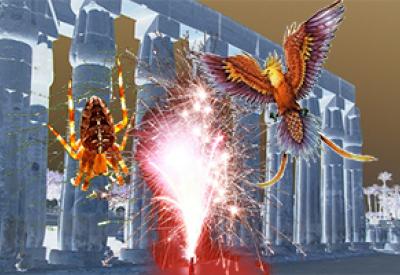
Jeff Dunn is a freelance critic with a B.A. in music and a Ph.D. in geologic education. A composer of piano and vocal music, he is a member of the National Association of Composers, USA, a former president of Composers, Inc., and has served on the Board of New Music Bay Area. A photomontage enthusiast, he illustrates his own reviews.
Articles by this Author
Many times people have asked me, shaking their heads: “How can anyone like that [dissonant, earsplitting, academic, boring, pointless, random — pick your adjective] modern music?” But the fact is, incredible as it may seem to some traditional classical music fans, many people do, as evidenced by the crowd filling the risers to near capacity in the Yerba Center for the Arts Forum Monday evening.
The draw was a milestone of Modernism, Pierre Boulez' Le Marteau sans maître (The hammer without a master, 1955), which took up the second half of the program.
The San Francisco Symphony program was simple and twain: just two works from the same Late Romantic era, divided by an intermission — works as different as Jekyll and Hyde.
More about San Francisco Symphony »Halloween has long gone, but Berkeley Symphony music director candidate Paul Haas arrived wearing a disguise Thursday night at Zellerbach Auditorium: that of a competent, careful, and traditional wandsman with barely enough energy befitting his relative youth (37). Appearances suggested someone who would make no waves, do a good job with the three B's, dabble in some contemporary music here and there — and be utterly predictable.
More »On Thursday, guest conductor Fabio Luisi brought a program to the San Francisco Symphony season that challenged performers and listeners alike. First he conducted Richard Strauss' multifaceted tone poem Don Juan, demanding a tempo in the faster portions as high as this month's Investor Panic index. Could the orchestra hold on? Later came Ravel's Tzigane, which starts off with a fiendishly difficult "cadenza" that gobbles up more than half the work.
More »If an often-played masterpiece is a warhorse, what is its opposite? I had just written about the benefits of unusual programming in the pastures of Arizona when, lo and behold, not one but three peacehorses galloped into the San Francisco Symphony’s Davies Hall, two of them bridled by überpianist Emanuel Ax, and a third paraded magnificently by guest conductor Peter Oundjian.
More »Is it like this for you? You go to the market. A Whitney Houston clone is on the Muzak — again. You want to scream. Do you feel the same way when you go to the symphony and discover Brahms' Second, Dvořák's "New World," or Mendelssohn's Violin Concerto on the program? If so, there's hope for you — if you move to north Phoenix. But more about that later.
There's no question about it: The "greats" rule the roost in classical music, and they're played over and over again.
The New Century Chamber Orchestra (NCCO), with its inspired choice of Nadja Salerno-Sonnenberg as its music director, has remade itself in such a way that its biggest problem is one that most musical organizations would be envious to have: too many syllables. The quality of performance is so high, the audience so engaged, the program so engaging within its class, and the charisma so omnipresent that now the only remaining barriers to national celebrity lie in the marketing arena.
More »How can one hour sum up 642,000 hours of a lifetime in music? Conrad Susa, 73, is being honored for his service to the San Francisco Conservatory of Music with the second hour of a concert on Saturday, Sept. 6. The two items of his on the program, the recent instrumental work The Blue Hour, and excerpts from his opera The Dangerous Liaisons, will display the refined, sensual aspects of his style — but will they tell of the most decisive change in his life? Or of the choice he made in the face of the modernist camp at Juilliard?
More »The final Music@Menlo concert, given last Thursday, was called "Music Now: Voices of Our Time." It should have been called "Recent Music That Pulls Your Heartstrings, Wrenches Your Guts, and Then Beats You to Death."
It began with a flat-out masterpiece for piano quintet, superbly performed, Scenes From the Poet's Dreams (1999) by Jennifer Higdon. In musically answering her own question, "What kind of dreams would poets have?" Higdon portrays five examples of such with consummate skill.
Concertgoers are lucky, compared to critics. They can simply like or dislike the music, but critics have to figure out why. At Saturday's Cabrillo Festival concert, after being tremendously disappointed by the clarinet concerto Riffs and Refrains by Mark Antony Turnage, a composer I normally admire, I couldn't put my finger on the reason.
More »Last month I witnessed an unusual spectacle at the Bergen Music Festival in Norway. After three or four curtain calls, clapping in unison began and, as if by prearranged signal, everyone stood at once in enthusiastic acknowledgement. The orchestra that did the playing was the visiting Stavanger Symphony Orchestra conducted by Ole Kristian Ruud. The music that did the arousing was a new “reconstruction” of the Julekvelden (Yule Eve) Symphony No. 1 by Geirr Tveitt. Who?
More "Rediscovering a Norwegian Master" »Three performances that ranged from superb to problematic, three pieces that ranged from problematic to superb — match up the combinations and you come up with Saturday's concert by the University Chorus and the University Chamber Chorus at Hertz Hall at UC Berkeley.
The concert began with a terrific rendition of Steve Reich's 1986 version (reduced strings, no brass) of Desert Music, with the University Chamber Chorus and Worn Ensemble, impressively conducted by David Milnes.
“The 51% Majority” was the title of the Empyrean Ensemble’s program of compositions by female composers last Friday at Old First Church in San Francisco. Of the featured music, 52.4 percent (three and two-thirds of the seven pieces) was unexceptional — no surprise considering that contemporary classical music hasn’t been time-filtered enough. But the rest made the concert more than worthwhile.
Tops for me was the first performance of Ann Callaway’s The Memory Palace (2006) for clarinet, cello, and piano. According to Callaway (b.
Last Wednesday, it was Laura Jackson’s turn to impress the Berkeley Symphony audience and perhaps follow Kent Nagano as music director. Hugh Wolff and Guillermo Figueroa showed their stuff earlier this season, and three more candidates are going to do the same this fall. How did she measure up? Let’s examine the criteria of programming choices, technique, interpretation, and orchestral management.
Jackson scored high marks for interesting selections.
I had to pinch myself. Nearly 200 schoolchildren at a string quartet concert listening to Bartók, and they're quieter than an equal number of old fogies like myself? Am I dreaming? Or did the Cypress String Quartet do mass hypnosis at the 19 schools it visited in the last three weeks before coming here to the Yerba Buena Center for the Arts?
More about Cypress String Quartet »Charles Amirkhanian, artistic director, Other Minds Festival: "How important is it for you to write something that’s never been heard before?"
Keeril Makan, assistant professor of music, MIT: "Nothing’s been heard before."
To this reviewer, however, everything at the third and final concert of the 13th Other Minds Festival at the Jewish Community Center of San Francisco on Saturday has been heard before, and was heard again and again, sometimes with pleasure, sometimes ad nauseam.
Minimalist procedures from the 1960s and
More »When does 180 miles equal light-years? When you hear Sibelius’ Seventh Symphony and Shostakovich’s Ninth on the same concert, and realize that the composers’ hometowns (Järvenpää and Leningrad) are that far apart from each other.
The symphonies are profound, and profoundly different.
Ed Sullivan, it is said, had a surefire method for putting together a successful show: Open big, schedule a good comedy act, put in something for children, and keep it clean. If only planning a symphony season were that easy. Sticking to Sullivan’s formula, a symphony would need to start each concert with something like Copland’s Fanfare for the Common Man, move on to a piece by, say, Offenbach, add Peter and the Wolf, and avoid anything dissonant.
No, it’s far more complicated than that.