<?xml version="1.0" encoding="UTF-8"?>
<!-- generator="wordpress/2.1.2" -->
<rss version="2.0"
	xmlns:content="http://purl.org/rss/1.0/modules/content/"
	xmlns:wfw="http://wellformedweb.org/CommentAPI/"
	xmlns:dc="http://purl.org/dc/elements/1.1/"
	>

<channel>
	<title>San Francisco Classical Voice</title>
	<link>http://www.sfcv.org</link>
	<description>The Bay Area's Most Complete Source for Classical Music News and Reviews</description>
	<pubDate>Wed, 07 May 2008 22:31:17 +0000</pubDate>
	<generator>http://wordpress.org/?v=2.1.2</generator>
	<language>en</language>
			<item>
		<title>Music News</title>
		<link>http://www.sfcv.org/2008/05/06/music-news-57/</link>
		<comments>http://www.sfcv.org/2008/05/06/music-news-57/#comments</comments>
		<pubDate>Tue, 06 May 2008 19:14:59 +0000</pubDate>
		<dc:creator>By Janos Gereben</dc:creator>
		
		<category><![CDATA[music news]]></category>

		<guid isPermaLink="false">http://www.sfcv.org/2008/05/06/music-news-57/</guid>
		<description><![CDATA[Serrand&#8217;s Magical Multimedia Mozart
If you have never heard Mozart&#8217;s The Marriage of Figaro, there is no better introduction to it than Steven Epp and Dominique Serrand&#8217;s Figaro, now playing at the Berkeley Repertory Theater. At the risk of raising eyebrows, after a lifetime of listening to Marriage, for me some of the bloom is off [...]]]></description>
			<content:encoded><![CDATA[<h2>Serrand&#8217;s Magical Multimedia Mozart</h2>
<p>If you have never heard Mozart&#8217;s <em>The Marriage of Figaro</em>, there is no better introduction to it than Steven Epp and Dominique Serrand&#8217;s <em>Figaro</em>, now playing at the <a href="http://www.berkeleyrep.org/season/0708/2246.asp">Berkeley Repertory Theater</a>. At the risk of raising eyebrows, after a lifetime of listening to <em>Marriage,</em> for me some of the bloom is off this obviously great music. Habit is a great deadener, alas.</p>
<p>At the Saturday matinee of <em>Figaro,</em> however, the music of Mozart&#8217;s opera — performed gloriously by singers I have not yet encountered elsewhere — came through once again fresh and glorious, speaking to the heart and misting the eye with its affecting insights into human nature and its yearning beauty. The production is a theatrical coup, a dazzling enterprise honoring Mozart as few proper opera performances do.</p>
<p>Based on Beaumarchais&#8217; little-known third play of the Figaro trilogy — the 1792 <em>La Mère coupable</em> (The guilty mother) — this Theatre de la Jeune Lune-originated musical play takes the 1775 <em>Barber of Seville</em> and 1784 <em>Marriage of Figaro</em> into the future of the two plays&#8217; characters. With &#8220;thanks and apologies to Beaumarchais, Mozart, and da Ponte,&#8221; <em>Figaro</em> opens in the French Revolution&#8217;s Reign-of-Terror phase.</p>
<p><img src="http://www.sfcv.org/images/repertoryfigaro_wide.jpg" class="photo" /></p>
<p class="caption">Dominique Serrand, as the old Almaviva, mourns the Countess</p>
<p class="photocredit">Photo by Michal Daniel</p>
<p>The old Count (Serrand) is hidden from the <em>enragés</em> (the Cultural Revolution crowd of those days) by the old Figaro (Epp), called <em>Fig</em>, and roundly abused by the delightfully dissolute Almaviva. In the first act&#8217;s dizzying, spectacular, funny whirlwind, the Beaumarchais trilogy is recounted and updated. The Countess (long estranged from the Count) is in the country with her son (and wait until you hear that story). Susanna went to live in America, where she is now in charge of the linen at the Jefferson household in Virginia.</p>
<p>(In that faraway land, there is no king, &#8220;not some divine sovereign with pretensions to be god on earth, not some flatulent monarch whose only claim to power is that his daddy was on the throne before him. No, a president, the voice of the people, elected by the people and for the people! His name is George. George &#8230; something with a W.&#8221;)</p>
<p><img src="http://www.sfcv.org/images/repertory2_wide.jpg" class="photo" /></p>
<p class="caption">Jennifer Baldwin Peden (the Countess) and Momoko Tanno (Susanna)</p>
<p class="photocredit">Photo by Michal Daniel</p>
<p>Even as in Sondheim&#8217;s <em>Follies</em>, old and young selves of characters meet, interact, or speak and sing over each other&#8217;s heads. The multimedia aspect of <em>Figaro</em> is wonderfully well handled, with live video close-ups of the actors and singers that provide the <em>sets,</em> while also enhancing our understanding.</p>
<p>Without the close-ups, it would be impossible to see and appreciate fully the tremendous acting prowess in the eyes and faces of Serrand, Epp, Jennifer Baldwin Peden (the most beautiful and elegant Countess since the young days of Elisabeth Schwarzkopf), Momoko Tanno (Susanna), Christina Baldwin (Cherubino), Bryan Boyce (young Figaro), and the big-voiced, show-stopper Bradley Greenwald (young Count), as well as all the other lively ghosts from the days of Figaro&#8217;s wedding.</p>
<p>The second act of the nearly three-hour-long production slows down, almost too much so, with more pauses, less manic action — but then some of Mozart&#8217;s most ravishing music is interpolated in context, leaving new fans and spoiled veterans in the same exalted place of bliss.</p>
<p>Live accompaniment is provided in a superb fashion by music director and pianist/harpsichordist Barbara Brooks, and the Seventh Avenue String Quartet (Justin Mackewich, Sarah Jo Zaharako, Katrina Weeks, and Alex Kelly). At the end, interrupting the standing ovation, Serrand led the entire cast off the stage to greet the audience at the exit, in an ultimate, timely, and most effective and affecting demolition of the fourth wall.</p>
<p>Even if it is obvious that in this case the third time was no charm, it&#8217;s been somewhat of a puzzle that while the first two Beaumarchais plays inspired operas by Paisiello, Mozart, Salieri, Rossini, Massenet, Corigliano, and others, <em>La Mère coupable</em> had only a solitary response, in a Milhaud opera of that name. Until now. <em>Figaro</em> is the definitive musical version, using the best possible material in the whole wide world, fortuitously in public domain.<br />
<img src="http://www.sfcv.org/images/repertory3_wide.jpg" class="photo" /></p>
<p class="caption">Steven Epp (&#8221;Fig&#8221;) and Dominique Serrand (Count Almaviva)</p>
<p class="photocredit">Photo by Kevin Berne</p>
<p class="backtotop"><a href="#top">Back to top</a></p>
<h2>S.F. Ballet Season Announcement</h2>
<p><a href="http://www.sfballet.org/">San Francisco Ballet</a>, which concludes its 75th anniversary season tonight, announced plans for next year in the War Memorial Opera House. Beginning with the usual <em>Nutcracker</em> run of 31 performances in December, the company will follow opening night on Jan. 21 with eight programs in a total of 56 performances alternating through May 9, 2009.</p>
<p>Highlights of the season include a new production of <em>Swan Lake</em>, three works Mark Morris has created for the company (<em>A Garden</em>, <em>Joyride</em>, and <em>Sandpaper Ballet</em>), and reprisals of these pieces from the current <a href="http://www.sfcv.org/2008/04/29/music-news-56/#anchor11">New Works Festival</a>: Stanton Welch&#8217;s <em>Naked</em>, Val Caniparoli&#8217;s <em>Ibsen&#8217;s House</em>, Christopher Wheeldon&#8217;s <em>Within the Golden Hour</em>, Yuri Possokhov&#8217;s <em>Fusion</em>, and Jorma Elo&#8217;s <em>Double Evil</em>.</p>
<p>Evening-long programs include Artistic Director Helgi Tomasson&#8217;s new <em>Swan Lake</em>, with scenery and costumes by opera and Broadway designer Jonathan Fensom; and George Balanchine&#8217;s <em>Jewels</em>, to music by Fauré, Stravinsky, and Tchaikovsky.</p>
<p class="backtotop"><a href="#top">Back to top</a></p>
<h2>Muti to Chicago</h2>
<p>After years of controversy in search of a successor to Daniel Barenboim as music director of the Chicago Symphony, the <a href="http://www.nytimes.com/2008/05/05/arts/music/05muti-web.html?ex=1210651200&amp;en=279fe3232ff4a588&amp;ei=5070&amp;emc=eta1">announcement</a> came Monday that Riccardo Muti, 66 — at one time of the Philadelphia Orchestra, and late of La Scala and a huge intramural <a href="http://www.nytimes.com/2005/04/03/arts/music/03waki.html?_r=1&amp;oref=slogin">struggle</a> there, which led to his resignation — will take the post, beginning in 2010, for at least five years.</p>
<p>While there can be no question about Muti&#8217;s artistic excellence, or of his current (visiting) leadership of the orchestra in Chicago, it remains to be seen if the match is a good one in extramusical terms. Barenboim left Chicago after 15 years, expressing frustration at his fund-raising duties, an inevitable part of being a music director of an American orchestra. A few months ago, Muti made the same point in rejecting the idea of taking over such responsibilities. And yet, on Monday, Muti said he was &#8220;fully committed to the duties of an American music director, including supervising auditions, helping raise funds, and engaging in community outreach.&#8221;</p>
<p><img src="http://www.sfcv.org/images/muti.richard_wide.jpg" class="photo" /></p>
<p class="caption">Riccardo Muti</p>
<p class="backtotop"><a href="#top">Back to top</a></p>
<h2>A.C.T Event With Lang, Chapman, Shive</h2>
<p>The American Conservatory Theater will conclude its Koret Visiting Artist Series on May 18 with <a href="http://www.act-sf.org/site/PageServer?pagename=interact_artist_panels"><em>Notes on Music and Theater</em></a>, featuring 2008 Pulitzer Prize–winning composer David Lang, Grammy Award–winning singer-songwriter Tracy Chapman, and Bay Area–based alternative rock cellist Bonfire Madigan Shive.</p>
<p>Lang has provided scoring for several A.C.T. productions, including <em>The Tempest</em>, <em>Hecuba</em>, and <em>The Difficulty in Crossing the Field</em>. Last month, he was awarded the Pulitzer Prize for Music for his <em>The Little Match Girl Passion</em>, based on the children&#8217;s story by Hans Christian Andersen.</p>
<p>&#8220;Music has played a large part of A.C.T. this season,&#8221; says Carey Perloff, the company&#8217;s artistic director. &#8220;And I can think of no better way to close out our Koret Visiting Artist series by exploring the relationship composers have with theater.&#8221; Admission is free to the event, which begins in the Geary Theater, at the conclusion of the matinee of <a href="http://www.act-sf.org/cursestarvingclass/index.html"><em>Curse of the Starving Class</em></a>, but seats should be reserved in advance from A.C.T.</p>
<p><img src="http://www.sfcv.org/images/lang.david1_wide.jpg" class="photo" /></p>
<p class="caption">David Lang</p>
<p class="backtotop"><a href="#top">Back to top</a></p>
<h2>SOS From Fremont Symphony</h2>
<p><a href="http://www.fremontsymphony.org/">&#8220;Save Our Fremont Symphony&#8221;</a> is the tell-all title of a <a href="http://www.fremontsymphony.org/SOS">fund-raising event</a> scheduled on May 10, from 2 to 6 p.m., at the Dominican Sisters of Mission San Jose. Among participants: the San Francisco Brass Quintet and the Steve Pietkiewicz Jazz Trio. Raffle prizes include private lessons with Fremont Symphony Music Director David Sloss.</p>
<p class="backtotop"><a href="#top">Back to top</a></p>
<h2><em>German Requiem</em>, Big and Small</h2>
<p>In modest competition with the San Francisco Symphony&#8217;s <a href="http://www.sfsymphony.org/season/Event.aspx?eventid=23448">presentation</a> of <em>Ein deutsches Requiem</em> (A German Requiem), <a href="http://www.choranova.org/">Chora Nova</a> is offering the work in Brahms&#8217; own two-piano version. Paul Flight is artistic director, the singers are soprano Rita Lilly and baritone Jeffrey Fields, and the pianists are Nalini Ghuman and Lino Rivera. The concert is on May 24, at 8 p.m., in Berkeley&#8217;s First Congregational Church.</p>
<p class="backtotop"><a href="#top">Back to top</a></p>
<h2>Whistling With Flicka: a True Story</h2>
<p>An adventurous writing colleague, Jason Victor Serinus, is also one of the world&#8217;s all-too-few classical concert whistlers. Last week, he reached a career high in that capacity, performing a duet with Frederica von Stade Herself. His story, the account of an artist from the inside:</p>
<blockquote><p>Besides the usual panic — oh no, did I leave my music at home? (It was in the trunk.) And, why am I driving through Golden Gate Park and going in circles when I should be driving down Van Ness? — I made it to the <a href="http://www.sophiaproject.org">benefit for Oakland&#8217;s Sophia Project</a> in plenty of time. I entered Fort Mason&#8217;s Conference Center as a large, lovely crowd of supporters was standing amidst absolutely gorgeous pottery and crafts, watching an inspiring film of the project&#8217;s remarkable work with homeless children and families.</p>
<p>Then the first set of performances began. Accompanied by Jim Meredith, it consisted of Flicka and high schoolers enrolled in a special low-income music program performing songs and arias. The singing was wonderful, but the program was long. Because most attendees were standing — there were only a few rows of seats, and they needed a break for more food, wine, and browsing — the set was concluded early.<br />
<img src="http://www.sfcv.org/images/vonstade.flicka_wide.jpg" class="photo" /></p>
<p class="caption">Frederica von Stade</p>
<p>I immediately approached the stage, and suggested to Flicka that we perform only one duet. That gave all the youth their opportunity, and the audience a break. It also allowed cellist Emil Miland the opportunity to play some gorgeous Bach, and Flicka the chance to blow us all away with the tipsy Offenbach that she had triumphed in with Los Angeles Opera a year or two ago.</p>
<p>Less than a half hour later, I&#8217;m standing in back when I hear the second set begin. Oops, I guess I&#8217;m on. I make my way to the front, and 10 minutes later, Flicka announces me and our duet. We take our places on opposite sides of the keyboard. I ask to speak.</p>
<p>First, I say that it&#8217;s undoubtedly insane for a music critic to stand up here in front of an audience with a singer whose performances he&#8217;s written about and dare try to duet with her. But here we are. Then I explain how Flicka and I met by phone, when I was writing a preview of the <em>Pauline Viardot and Friends</em> salon she performed with Marilyn Horne, Vladimir Chernov, and Melody Moore. My spiel went something like this:</p>
<p>&#8220;And then, while talking about the Sophia Project, Flicka said, &#8216;What else are we going to do if we don&#8217;t address the situation and serve these children? Build a prison on every street corner?&#8217;&#8221;</p>
<p>&#8220;At that point, I replied, &#8216;Oh honey, I hear you. We are so on the same page. I deal with this all the time on the Oakland Community Policing Task Force.&#8217; Shortly after that, I told her that I had fantasized performing Mozart&#8217;s letter duet, &#8220;Sull&#8217;aria,&#8221; with her for 15 years. She was remarkably open to the concept, and immediately proposed that we do so at this benefit.&#8221;</p>
<p>Time for the music. Hardly anyone in the audience had ever heard me before. It is fair to say that they were stunned. Some giggled, which was cool, as they discovered my whistling carrying as well as many of the voices on the program, and got used to my bright, intentionally Mozartian sound. They especially loved my appoggiatura.</p>
<p>In my sole rehearsal with Flicka, I had stared at the sheet music, trying to stick to my line while dueting with a major operatic presence. Here, after lots of practice, I was relaxed enough to gaze up at Flicka several times as our voices were answering each other. The second time, as she found me looking right at her, whistling the words she had just sung, she cracked up. It was hilarious. Somehow, I kept going without blinking an eye.</p>
<p>Musically, it went wonderfully. The audience cheered, bravoed, yelled, hollered &#8230; it was a total, total joy.</p>
<p>Flicka is one of the most generous, openhearted opera singers I have ever encountered. I hope to have the privilege of performing with her again. Don&#8217;t miss her San Francisco Opera performance next season of Jake Heggie&#8217;s <em>Three Decembers</em>, which he wrote especially for her.</p></blockquote>
<p class="backtotop"><a href="#top">Back to top</a></p>
]]></content:encoded>
			<wfw:commentRss>http://www.sfcv.org/2008/05/06/music-news-57/feed/</wfw:commentRss>
		</item>
		<item>
		<title>Near-Reckless Brilliance</title>
		<link>http://www.sfcv.org/2008/05/06/near-reckless-brilliance/</link>
		<comments>http://www.sfcv.org/2008/05/06/near-reckless-brilliance/#comments</comments>
		<pubDate>Tue, 06 May 2008 19:08:49 +0000</pubDate>
		<dc:creator>By Michelle Dulak Thomson</dc:creator>
		
		<category><![CDATA[review]]></category>

		<category><![CDATA[symphony]]></category>

		<guid isPermaLink="false">http://www.sfcv.org/2008/04/29/near-reckless-brilliance/</guid>
		<description><![CDATA[There&#8217;s a certain satisfaction to be derived from designing a program that combines a narrow focus with enough variety to work as an actual concert, and I imagine that San Francisco Symphony Associate Conductor James Gaffigan was modestly proud of the one he and the orchestra brought off Thursday afternoon. On paper the focus was, [...]]]></description>
			<content:encoded><![CDATA[<p>There&#8217;s a certain satisfaction to be derived from designing a program that combines a narrow focus with enough variety to work as an actual concert, and I imagine that San Francisco Symphony Associate Conductor James Gaffigan was modestly proud of the one he and the orchestra brought off Thursday afternoon. On paper the focus was, in one way, laser-tight: three works of Russian composers, all dating from within a few years of one another in the 1940s.</p>
<p>But when one of those is Shostakovich&#8217;s arduous, anguished First Violin Concerto, another Rachmaninov&#8217;s splashy <em>Symphonic Dances,</em> and the third Stravinsky as orchestrator giving his best Tchaikovsky impression, the commonalities seem engulfed by the vast differences of milieu, style, and substance. Indeed, the greatest audible commonality Thursday may have been the disciplined brilliance of the playing, both of the Symphony players and of the soloist in the Shostakovich, violinist Vadim Gluzman.</p>
<p>Not long ago the Shostakovich First was rarely played, but it seems lately to have joined the small clutch of 20th-century concertos every young violin soloist is expected to know. It is a demanding and largely bleak work, dominated by two sizable slow movements and strikingly, if darkly, scored. As one of the pieces Shostakovich shelved for a time around his harrowing travails in 1948, and as (I think) the first of his works to use the “DSCH” motto theme that was to become so familiar in his later works, it occupies a pivotal place in the composer&#8217;s output.</p>
<p>(I hesitate to quibble with an annotator so august as Michael Steinberg, who wrote the Symphony&#8217;s program note, but it&#8217;s not quite right to say, as he does, that the winds in the second movement of the concerto announce the “DSCH” theme. “DSCH” — the notes D, E-flat, C, and B-natural, in German usage — ends with the downward half step between C and B, while the winds&#8217; four-note motif ends with a downward whole step. You <em>do</em> hear “DSCH” — transposed, yet with the right intervals — in the concerto, but only three times: once at the very end of the second movement and twice in the cadenza, and all three times only in the solo violin part. To me that seems significant.)</p>
<p>Gluzman stepped in as soloist in the Shostakovich after the originally scheduled Vadim Repin canceled. The two have more in common than the coincidence of their first names. Gluzman has studied with Zakhar Bron, the Novosibirsk-based violin pedagogue among whose pupils Repin and Maxim Vengerov are perhaps the best-known.</p>
<p>I didn&#8217;t catch Gluzman&#8217;s recent Tchaikovsky Concerto with the Marin Symphony (see the <em>SFCV</em> review <a href="http://www.sfcv.org/2008/01/22/opposite-attractions/">here</a>). I was kicking myself for that omission once the enthusiastic reports of various members of the orchestra began filtering back to me. Hearing Gluzman&#8217;s fine new recording of that work, which hit the street immediately afterward, only made the regret keener. (The disc, containing the Glazunov Concerto and the three pieces of Tchaikovsky&#8217;s Op. 42 <em>Souvenir d&#8217;un Lieu cher</em> in addition to the Tchaikovsky Concerto, is BIS SACD-1432; you can listen to excerpts online <a href="http://free.napster.com/player/album/12748708">here</a>.)</p>
<h2>Cord of Sanity</h2>
<p>The rich, dark tone and sinewy strength of Gluzman&#8217;s recorded Tchaikovsky were also the glories of Thursday&#8217;s Shostakovich. The violinist took this assignment at relatively short notice. That he had recourse to the printed music in concert would seem to suggest that he was not yet entirely at ease with the score, but you would never have guessed as much with your eyes closed.</p>
<p>In the slow first and third movements, Gluzman&#8217;s deep, concentrated sound and the powerful evenness of his bowing were striking. There was relatively little of the self-conscious vulnerability some violinists have taken to exhibiting in this music. Gluzman&#8217;s protagonist appeared to be beset by great sorrows and anxieties, but not actually reduced to an emotional wreck. A cord of sanity and strength ran through the playing, however hysterical the music grew.</p>
<p>That made the enormous third-movement cadenza, for example, more straightforward, less ruminative than it often is, but at the same time more cogent. What it lacked in artful local inflection was more than made up for in emotional directness and urgency. The same went, indeed, for both the slow movements themselves. I admired in particular Gluzman&#8217;s way with the opening “Nocturne,” where he conveyed the impression of (if you will) resolutely purposeful wandering as well as any violinist I&#8217;ve heard.</p>
<p>I was reminded there of the concerto&#8217;s dedicatee, David Oistrakh, whose recorded performances of it give that same impression of inner solidity. As an approach to the slow movements, it has the additional merit of making the other two movements seem less gratuitous, less incongruous. Gluzman was breathtaking in the fast movements, slashing of attack and hurtling forward at speeds that would have seemed reckless had he not been in such evident technical control.</p>
<p>The orchestra dug into Shostakovich&#8217;s rich, reedy sonorities with relish, though they were not always in perfect coordination with the solo violin. Gluzman left conductor Gaffigan momentarily in the dust once or twice in the fast movements, and in the great third-movement passacaglia, too, minute disagreements were heard between the solo violin line and one or another of the wind lines.</p>
<h2>On the Wing</h2>
<p>If the Shostakovich performance made the rest of the program seem comparatively pale, that&#8217;s no fault of the playing. The opening bonbon, Stravinsky&#8217;s 1941 orchestration of the “Bluebird&#8221; pas de deux from Tchaikovsky&#8217;s <em>Sleeping Beauty,</em> proved to feature Stravinsky the able mimic more than Stravinsky the ironic, distancing appropriator of older music. This is not so surprising, given that it was written to slot into a performance of the Tchaikovsky score (parts of the ballet were long available outside the Soviet Union only in piano reduction).</p>
<p>Apart from the necessary reduction of the orchestral string sections to pit-orchestra dimensions (here they were five violins on a single part, four violas, three cellos, and two basses) and the addition of a piano, Stravinsky stuck plausibly close to Tchaikovsky&#8217;s own manner. The Symphony players, led appealingly by principal flutist Tim Day in the part of the eponymous Bluebird and seconded by clarinetist Luis Baez, were bubbly, lithe, and graceful.</p>
<p>So was Gaffigan at their helm, perhaps to excess: I don&#8217;t think I&#8217;ve ever seen a conductor give such meticulous, dancerlike attention to the way line flows from his arms through his wrists to his fingertips. It looked most elegant from the back, but I wonder how easy it is to follow.</p>
<p>As for Rachmaninov&#8217;s big, brawny <em>Symphonic Dances,</em> from 1940, both the Symphony and Gaffigan were in taut control of a score that, like most of the composer&#8217;s large-scale music, runs a continual risk of sprawl. The playing throughout was crisply and almost casually virtuosic, light on its feet without ever sounding thin or underpowered.</p>
<p>Gaffigan let the orchestra linger in the juicy spots (like the sax-led second theme of the first movement), but the dominant impulse was forward, with an urgency that lent a ghostly whirl to the waltz of the second movement and bore the finale, “Dies irae” references and all, straight and purposefully through to its conclusion.</p>
]]></content:encoded>
			<wfw:commentRss>http://www.sfcv.org/2008/05/06/near-reckless-brilliance/feed/</wfw:commentRss>
		</item>
		<item>
		<title>From Beautiful to Dutiful</title>
		<link>http://www.sfcv.org/2008/05/06/from-beautiful-to-dutiful/</link>
		<comments>http://www.sfcv.org/2008/05/06/from-beautiful-to-dutiful/#comments</comments>
		<pubDate>Tue, 06 May 2008 19:07:14 +0000</pubDate>
		<dc:creator>By Janice Berman</dc:creator>
		
		<category><![CDATA[review]]></category>

		<category><![CDATA[dance]]></category>

		<guid isPermaLink="false">http://www.sfcv.org/2008/05/06/from-beautiful-to-dutiful/</guid>
		<description><![CDATA[Were it not the brainchild of Artistic Director Helgi Tomasson, a festival marking the San Francisco Ballet&#8217;s 75th anniversary by presenting 10 new ballets in one week (three programs in all) would be regarded as a fool&#8217;s errand. Some fool. Some errand.
It&#8217;s a success. Not all the ballets are fabulous, but the music and dancing [...]]]></description>
			<content:encoded><![CDATA[<p>Were it not the brainchild of Artistic Director Helgi Tomasson, a festival marking the San Francisco Ballet&#8217;s 75th anniversary by presenting 10 new ballets in one week (three programs in all) would be regarded as a fool&#8217;s errand. Some fool. Some errand.</p>
<p>It&#8217;s a success. Not all the ballets are fabulous, but the music and dancing that propels them is unequivocally wonderful, permeating the air in the War Memorial Opera House with a sense of fizzy delight. Among the clearest triumphs are Margaret Jenkins&#8217; <em>Thread</em> and Val Caniparoli&#8217;s <em>Ibsen&#8217;s House,</em> inhabitants of Program C alongside Jorma Elo&#8217;s <em>Double Evil.</em> Both bear the lineaments of narrative in practically opposite ways.<br />
<img src="http://www.sfcv.org/images/thread_wide.jpg" class="photo" /></p>
<p class="caption">The San Francisco Ballet in Margaret Jenkins&#8217; <em>Thread</em></p>
<p class="photocredit">All photos by Erik Tomasson</p>
<p>Modern choreographer Jenkins&#8217; piece, danced in soft shoes to a luminously melodic, eponymous new work by Paul Dresher, and created in collaboration with her own company, jumps off from the Greek myth of Ariadne and its accompanying spiders, webs, and Minotaur. Dancer Pauli Magierek, the golden, magnetic presence at the center of <em>Thread,</em> and her partner, Damian Smith, had the task of enacting what is really an abstract series of fragments, adding up to a kind of inborn human legend. The rest of the cast would flesh it out.</p>
<p>It&#8217;s Jenkins&#8217; facility for evoking imagery through movement that let the dancers do it. They had helped in the conception of this world of spider webs and mazes and menaces, and it captured the audience&#8217;s imagination. <em>Thread</em> is proof of what can be created through artistry, craft, and belief. We could say something here about the seamlessness of the creative weave between a great ballet company and a great modern one like Margaret Jenkins Dance, but you can say it better yourself.</p>
<p>Caniparoli&#8217;s <em>Ibsen&#8217;s House,</em> set to Dvořák&#8217;s Piano Quintet in A Major, Op. 81, uses the five strong, long-suffering heroines of his plays, most prominently <em>Hedda Gabler,</em> in a series of driven solos and pas de deux (with the domineering men in their lives), beautifully on pointe as well as to the point.<br />
<img src="http://www.sfcv.org/images/feijoo2_wide.jpg" class="photo" /></p>
<p class="caption">Lorena Feijoo and David Arce in Val Caniparoli&#8217;s <em>Ibsen&#8217;s House</em></p>
<p>As Hedda, Lorena Feijoo, perhaps the strongest actress in the company, set the tone, a balance of endurance and frustration, bringing it forward with compelling technique. Caniparoli&#8217;s greatest success is in deploying dancers through the stage space; at one point, Feijoo&#8217;s Hedda springs backward on a diagonal arabesque, and is joined suddenly in midflight by Courtney Elizabeth, as Ellida Wangel in <em>Lady from the Sea.</em> Widely spaced, the two characters are visibly of the same spirit, facing the same challenges. Fine performances from all, but in particular Clara Blanco, the aforementioned Elizabeth, Patricia Perez, and Steven Norman added to the sense of drama, while the unaccountably dim lighting detracted from it. Dvořák and dancers had the benefit of a glorious quintet, illumined beneath stage right: Roy Bogas, piano; Roy Malan and Craig Reiss, violins; Paul Ehrlich, viola; and David Kadarauch, cello.</p>
<p>Although the Elo ballet missed the boat by making the ballerinas (dressed in teeny-tiny tutus, with white underpants) look foolish while trying, through the modern-day miracle of deconstruction, to defend them — yet another reason deconstruction doesn&#8217;t work, unless William Forsythe is having at it — <em>Double Evil</em> was full of extravagant pyrotechnics, and Philip Glass&#8217; shimmering yet percussive <em>Concerto Fantasy for Two Timpanists and Orchestra,</em> movements 1 and 3, joined with Vladimir Martynov&#8217;s <em>Come In!,</em> movements I and V, nearly saved the day.</p>
<h2>It&#8217;s Got Legs</h2>
<p>On Program A, <em>Within the Golden Hour,</em> a fluent creation from the articulate Christopher Wheeldon, has, to coin an expression, legs. It&#8217;s set to seven widely varied pieces by Ezio Bosso, who writes at times like an irksome Phillip Glass, and was conducted by David Briskin, with Roy Malan and Paul Ehrlich on violin and viola respectively. Long (but not an hour) yet rewarding, it featured two of the company&#8217;s finest ballerinas, Katita Waldo (partnered by Brett Bauer) and Tina LeBlanc (with Garrett Anderson). Wheeldon steps playfully outside Neoclassicism for some of his pas de deux, imbuing passages with Latin sensibilities, but returns at appropriate moments to high-lifting, high-falutin&#8217; derring-do.<br />
<img src="http://www.sfcv.org/images/wheeldon_wide.jpg" class="photo" /></p>
<p class="caption">S.F. Ballet in Christopher Wheeldon&#8217;s <em>Within the Golden Hour</em></p>
<p>Yuri Possokov&#8217;s <em>Fusion,</em> notwithstanding its meticulous deployment, looks a little goofy. Not so much fusion as awkward juxtaposition, the new ballet places four worldly couples — contemporary-looking dancers — next to four men in long white skirts and boxy hats who execute wonderful Sufi-style spins. Nobody looks much at home, though the couples are continually impressive, moving through smooth lifts, angular poses, and perfect promenades balanced on one point. Maria Kochetkova, a recent principal hire, has fire in every fiber. The ensemble of a dozen musicians playing Graham Fitkin and Rahul Dev Burman, the latter from Kronos and arranged by Golijov, included Jim Santi Owen on tabla and David Rosenthal on marimba.</p>
<p>Paul Taylor&#8217;s evocation of the 1960s, <em>Changes,</em> set to the music of Mamas and the Papas (including <em>I Call Your Name</em> and <em>California Dreamin&#8217;</em>), Lennon/McCartney, and John Hartford, all on recording, was frankly a bit of a disappointment. The set for <em>Changes</em> was darkly lit. The music, beginning with <em>Straight Shooter,</em> was raw, not studio-smoothed. The dancers wore Santo Loquasto&#8217;s perfect evocations of hippie peace, evinced hippie love, and smoked hippie cigarettes. Taylor seemed to be trying to convey several moods at the same time — he has built his reputation on his ability to do so, especially in works like <em>Esplanade</em> and <em>Le Sacre du Printemps/The Rehearsal.</em> Anyway, that&#8217;s exactly what the &#8217;60s were like. Happy. Sad. It was, he observed in his program note, about like things are now. &#8220;While this era was singular in many ways, the impulse for change is not — the more things change, the more they stay the same.&#8221;<br />
<img src="http://www.sfcv.org/images/changes_wide.jpg" class="photo" /></p>
<p class="caption">S.F. Ballet in Paul Taylor&#8217;s <em>Changes</em></p>
<p>Paul Taylor&#8217;s own company was young then. They went to Paris during the 1968 student riots, where Taylor hurt himself dancing. Then, with his ankle in a cast, he found himself face to face with Danny the Red, who didn&#8217;t want Taylor&#8217;s company to perform at the Odeon. And they didn&#8217;t. Taylor&#8217;s wonderful autobiography, <em>Private Domain,</em> makes it a hilarious story, but there&#8217;s nothing funny about a dancer with a busted ankle and a dance company with no money. So there you are, and today Paul Taylor can show everyone how to create a smooth and lively piece, well-staged by Taylor alum Patrick Corbin, with great dancing, particularly from Dana Genshaft, Mariellen Olson, Aaron Orza, and Jeremy Rucker; glimpses of joy, an undercurrent of sorrow, and, from this onlooker, a wish to see more. Ah, well. California dreamin&#8217;.</p>
<h2>Not Quite the Go-to Program</h2>
<p>Frankly, on the face of it B, not C, looked like the go-to program. It offered a new Mark Morris, a new James Kudelka, a new Julia Adam, a new Stanton Welch. All had compelling moments that none, regrettably, was able to sustain. Adam&#8217;s <em>A rose by any other name,</em> set to some of Bach&#8217;s <em>Goldberg Variations,</em> was confusing. Adam&#8217;s appropriations of Petipa fairy moves from <em>The Sleeping Beauty</em> for her ballerinas, especially Kristin Long&#8217;s Aurora, offered enchanting reminders of the value of the classics, probably not quite what the choreographer was aiming for.<br />
<img src="http://www.sfcv.org/images/rosebyanyother_wide.jpg" class="photo" /></p>
<p class="caption">S.F.Ballet in Julia Adam&#8217;s <em>A rose by any other name</em></p>
<p>Australian choreographer Stanton Welch&#8217;s ballet, <em>Naked,</em> in its tutu traditionalism (lovely and blue, by Holly Hynes, but surmounted by flesh-colored tops), feels like the postwar &#8217;40s with a touch of Hollywood, set to Poulenc&#8217;s Concerto in D Minor for Two Pianos. Welch&#8217;s training was British and his parents were ballet dancers. As its title implies, <em>Naked</em> displays more vulnerability than a traditional plotless ballet, particularly in its allusion to blindness, when the dancers cover their eyes, not a new thing — see Balanchine&#8217;s <em>Serenade</em> — but nonetheless affecting and mysterious. The fine dancers were Kristin Long, Yuan Yuan Tan, Pascal Molat, and Ruben Martin in principal roles, with soloists Frances Chung, Nicole Grand, Elizabeth Miner, Brett Bauer, Hansuke Yamamoto, and Nicolas Blanc. Roy Bogas and Michael McGraw were the pianists.</p>
<p>Kudelka&#8217;s <em>The Ruins Proclaim the Building Was Beautiful,</em> set to music of that name by Rodney Sharman after Cesar Franck, a dense and lovely dreamscape, never quite achieves transcendence but is a most interesting effort. James Searle&#8217;s impeccably ragged tutus look wonderful on circling, sorrowing women, legs raised in arabesque like involuted Shades from <em>La Bayadere. </em>James F. Ingalls&#8217; glowing lighting is burnished by the music&#8217;s mournful brass. Yuan Yuan Tan and Pierre-Francois Villanoba lead a dozen other dancers through tattered dreams and recollections, some convulsive. Tan becomes passive victim to Villanoba, who, in his frock coat, takes on the attributes of a vampire.<br />
<img src="http://www.sfcv.org/images/joyride2_wide.jpg" class="photo" /></p>
<p class="caption">S.F. Ballet in Mark Morris&#8217; <em>Joyride</em></p>
<p>Mark Morris&#8217; <em>Joyride,</em> set to John Adams and conducted by Music Director Martin West, who&#8217;s done an amazing job of coordinating the festival&#8217;s entire musical output, looks great. It has costumes by Isaac Mizrahi — what the Tin Man would wear if he could choose gold — plus an electronic random-numeral display on each dancer&#8217;s chest. <em>Joyride</em> is supremely professional, fast, and cheerful, whether airborne or floor-bound, and not really enough of anything, which is different from the show-biz adage of &#8220;always leave them wanting more.&#8221; Gennadi Nedvigin seems at last to be getting appreciated for what he can whip off in the way of amazements — split jumps, spins, fouettés — and the rest of the cast also is absolutely marvelous as it steps up, crouches down, hits weird, sharp arm positions, angling with strength. It&#8217;s Morris meritorious, but not terrific. Give it, oh, an 8.</p>
]]></content:encoded>
			<wfw:commentRss>http://www.sfcv.org/2008/05/06/from-beautiful-to-dutiful/feed/</wfw:commentRss>
		</item>
		<item>
		<title>The Strings Have It</title>
		<link>http://www.sfcv.org/2008/05/06/the-strings-have-it/</link>
		<comments>http://www.sfcv.org/2008/05/06/the-strings-have-it/#comments</comments>
		<pubDate>Tue, 06 May 2008 19:07:00 +0000</pubDate>
		<dc:creator>By Alexander Kahn</dc:creator>
		
		<category><![CDATA[review]]></category>

		<category><![CDATA[symphony]]></category>

		<guid isPermaLink="false">http://www.sfcv.org/2008/05/06/the-strings-have-it/</guid>
		<description><![CDATA[Audiences jumped to their feet for standing ovations after performances by the Philharmonia on both Sunday and Monday at Davies Symphony Hall, presented by the San Francisco Symphony. The venerable orchestra was in town for a set of concerts under Christoph von Dohnányi, the ensemble&#8217;s principal conductor. Consistently rated as one of the top 10 [...]]]></description>
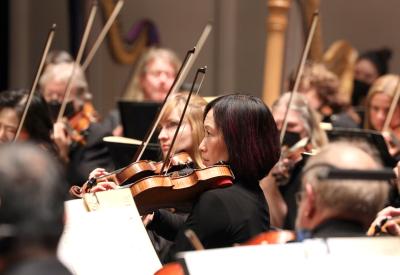
			<content:encoded><![CDATA[<p>Audiences jumped to their feet for standing ovations after performances by the Philharmonia on both Sunday and Monday at Davies Symphony Hall, presented by the San Francisco Symphony. The venerable orchestra was in town for a set of concerts under Christoph von Dohnányi, the ensemble&#8217;s principal conductor. Consistently rated as one of the top 10 orchestras of Europe, the Philharmonia delivered impeccable intonation, phrasing, dynamics, and virtuosity, just as it has done on countless recordings. But therein lay the problem.</p>
<p>The Philharmonia is, according to the orchestra&#8217;s Web site, &#8220;the world&#8217;s most recorded orchestra,&#8221; with some 1,000 recordings to its credit. Founded in 1945 by the legendary record producer Walter Legge, the orchestra has been led by the finest conductors in the world, including Karajan, Klemperer, Muti, and Sinopoli. Dohnányi, now in his last season as principal conductor, will be succeeded in that position next season by Esa-Pekka Salonen, but will stay on with the orchestra as Honorary Conductor for Life.<br />
<img src="http://www.sfcv.org/images/philharmoniaorchestra_wide.jpg" class="photo" /></p>
<p class="caption">Members of the Philharmonia Orchestra</p>
<p>Make no mistake about it: The orchestra is in terrific shape. Its hallmark string sound — warm, well-balanced, and rich — was on full display. Many critics have claimed that this sound is a legacy of the orchestra&#8217;s Central European heritage (its years under Karajan and Klemperer), and Dohnányi has done well to continue this tradition.</p>
<p>For me, the highlights of the concerts were the moments when I was able to enjoy slow and quiet passages that featured the strings, such as the second movement of Schumann&#8217;s First Symphony, played on Sunday night. The movement showed off well the ensemble&#8217;s ability to create beauty through careful attention to bow speed, ornamentation, accentuation, and balance between inner and outer voices. The strings also have an uncanny ability to play extremely softly and yet sound fully resonant, an ability that was on display in the Schumann and also in the first movement of Schubert&#8217;s &#8220;Unfinished&#8221; Symphony, performed Monday night.</p>
<p>While the Philharmonia&#8217;s string sections have always been lauded, its winds have on occasion come under critical fire. From my seat (near the front of the hall in the orchestra section) I found that the winds were consistently overbalanced. Throughout both concerts, it seemed as if special care was being taken to blend the wind sound into the string texture. While this produced wonderful results in terms of sheer sonic beauty, I found myself frustrated by the lack of individual voices coming from the winds, especially during solo sections. And during all but the most climactic of sections, the brass held back and never came to the fore of the texture. Again, this produced beautiful, rounded results, but after hours of such roundness I found myself longing to hear some sharp edges.</p>
<h2>Little Sense of Urgency</h2>
<p>Here lies the crux of my frustration with the concerts: While the ensemble cannot be faulted on its sound quality or its attention to detail, there was a general lack of excitement and energy, not only from the brass but from the entire ensemble. Dohnányi&#8217;s tempi were consistently on the conservative side, ensuring perfect execution but excluding any sense of urgency in faster movements or spaciousness in the slower movements.</p>
<p>Time and again this proved a problem, from the stodgy third movement of the Schumann on Sunday to the earthbound Finale of Beethoven&#8217;s Fifth Symphony on Monday. Matters were made worse by the conductor&#8217;s decision to summon the orchestra&#8217;s full string forces for the performances of the Schubert and the Beethoven, creating an unpleasant sense of heaviness.</p>
<p>All these problems came together in the performance of Mahler&#8217;s First Symphony on Sunday night. Dohnányi consistently chose the tempo of least resistance, ignoring many tempo modifications, both traditional and written. This was a Mahler largely devoid of color, with flawless, beautiful, but drab execution throughout. Once more, the musicians proved their virtuosity time and again throughout the performance, yet without any sense of risk or passion.</p>
<p>The highlight of the two evenings, to my ears, came not during the programmed works at all, but rather with Monday night&#8217;s encore, Brahms&#8217; <em>Hungarian Dance</em> No. 1. For a few minutes, the orchestra performed with verve and excitement, with a sense of abandon and a wild degree of flexibility in terms of tempo. This is the orchestra I had wanted to hear all night — and the night before. Clearly, this orchestra is capable of great beauty <em>and </em>great passion. Next time, can we have more of that, instead of more of the same?</p>
]]></content:encoded>
			<wfw:commentRss>http://www.sfcv.org/2008/05/06/the-strings-have-it/feed/</wfw:commentRss>
		</item>
		<item>
		<title>Exploring Styles of Performing</title>
		<link>http://www.sfcv.org/2008/05/06/exploring-styles-of-performing/</link>
		<comments>http://www.sfcv.org/2008/05/06/exploring-styles-of-performing/#comments</comments>
		<pubDate>Tue, 06 May 2008 19:06:55 +0000</pubDate>
		<dc:creator>By Noel Verzosa</dc:creator>
		
		<category><![CDATA[review]]></category>

		<category><![CDATA[chamber orchestra]]></category>

		<guid isPermaLink="false">http://www.sfcv.org/2008/04/05/exploring-styles-of-performing/</guid>
		<description><![CDATA[Last December, Kent Nagano and Stuart Canin unveiled the Berkeley Akademie Ensemble, a project designed to cultivate &#8220;explorations of style&#8221; and &#8220;develop ensemble technical skills&#8221; (as the organization describes its goals). Thursday marked the Akademie&#8217;s second concert, held in Berkeley&#8217;s First Congregational Church.
One way in which the Akademie challenges its musicians is through its revival [...]]]></description>
			<content:encoded><![CDATA[<p>Last December, Kent Nagano and Stuart Canin unveiled the Berkeley Akademie Ensemble, a project designed to cultivate &#8220;explorations of style&#8221; and &#8220;develop ensemble technical skills&#8221; (as the organization describes its goals). Thursday marked the Akademie&#8217;s second concert, held in Berkeley&#8217;s First Congregational Church.</p>
<p>One way in which the Akademie challenges its musicians is through its revival of the practice (pre-19th century) of the conductorless orchestra. In performances of C.P.E. Bach&#8217;s Symphony in C Major, W. 182, No. 3 (1773), and Stravinsky&#8217;s <em>Apollon musagète </em>(1927), the Akademie players relied only on each other, with occasional help from Canin as concertmaster, to stay together in these two demanding scores.</p>
<p>Playing without a conductor is especially daunting in C.P.E. Bach&#8217;s schizophrenic music. Even the most tranquil passages can give way to outbursts of 16th and 32nd notes without a moment&#8217;s warning. Perhaps out of necessity, the Akademie minimized contrasts in dynamics and expressive character in order to pull off the feat. The ensemble managed to keep together while navigating the score, but the composer&#8217;s erratic and improvisatory style was sometimes lost. In an effort to give the music shape, crescendos and decrescendos were applied almost perfunctorily.</p>
<p>This did not greatly diminish the orchestra&#8217;s achievement, however. The downsized ensemble (consisting only of string instruments and harpsichord), coupled with the church&#8217;s vibrant acoustics, provided the best of both worlds: the textural clarity of an &#8220;early music&#8221; ensemble with the majestic resonance of a full orchestra.</p>
<p>If the liveliness of the &#8220;Classical style&#8221; was somewhat tamed, it is a sound that modern audiences have nonetheless grown accustomed to, largely through the legacy of the second composer of the evening. Apollon musagète belongs to Stravinsky&#8217;s &#8220;Neoclassical&#8221; period, a particularly cold, [a]stringent phase of the composer’s career. Disdaining as he did the emotional excesses of Romanticism, Stravinsky might well have welcomed the orchestra sans conductor as a way to minimize the &#8220;deformation&#8221; (his word for performers&#8217; personal interpretation) imposed on his works.</p>
<h2>Challenged by Lack of a Conductor</h2>
<p>The absence of a maestro again proved a considerable obstacle. <em>Apollon musagète </em>is permeated with the propulsive dotted rhythms of French Baroque music. Without a conductor helping to articulate the tempo, however, the orchestra plodded through these rhythms with heavy feet, as if forgetting that the music was written for the ballet.</p>
<p>The orchestra locked into form in time for the Coda, the most kinetically engaging movement of the piece. Here, with the help of pervasive syncopation and numerous metrical shifts, Stravinsky&#8217;s Baroque rhythms seemed to transform into the &#8220;swing&#8221; rhythms of Dixieland jazz. Stealing glances at my fellow concertgoers, I distinctly saw heads tentatively bopping, feet innocuously tapping.</p>
<p>After the string-dominated first half, the appearance of woodwinds and brass in Mozart&#8217;s &#8220;Posthorn&#8221; Serenade in D, K. 320 (1779), gave the orchestra a delightfully startling depth of sound, like a black and white photo suddenly recast into blazing hi-def color. The woodwinds, in particular, played with a purity (not a Stravinskian, abstract purity but a Mozartian, <em>human </em>purity) that was at times breathtaking.</p>
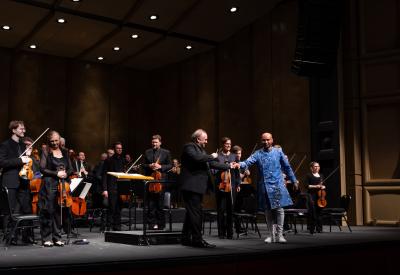
<p>The Mozart Serenade also saw Nagano taking the conducting reins, and the result was a blast of fresh air. The muddiness of the first half was transformed into a crystalline sheen. The orchestra handled dynamics and rhythm with much greater nuance. While the &#8220;dance&#8221; movements of the Serenade were not actually intended for dance (the piece was written to accompany a graduation ceremony), Nagano&#8217;s crisp, rhythmic precision made the piece more evocative of physical movement than Stravinsky&#8217;s ballet.</p>
<p>The &#8220;Classical style&#8221; is still a contested idea today. Only recently have musicians begun to untangle it from the 20th-century &#8220;Neoclassicism&#8221; with which it used to be conflated. Although the latter tends to sacrifice personality and expression for clarity and precision, Nagano and the Berkeley Akademie Ensemble gave the audience a welcome reminder that it is possible to have both.</p>
]]></content:encoded>
			<wfw:commentRss>http://www.sfcv.org/2008/05/06/exploring-styles-of-performing/feed/</wfw:commentRss>
		</item>
		<item>
		<title>Scaling the Bartók-Ravel Summit</title>
		<link>http://www.sfcv.org/2008/05/06/scaling-the-bartok-ravel-summit/</link>
		<comments>http://www.sfcv.org/2008/05/06/scaling-the-bartok-ravel-summit/#comments</comments>
		<pubDate>Tue, 06 May 2008 19:06:29 +0000</pubDate>
		<dc:creator>By Janos Gereben</dc:creator>
		
		<category><![CDATA[review]]></category>

		<category><![CDATA[opera]]></category>

		<guid isPermaLink="false">http://www.sfcv.org/2008/04/29/scaling-the-bartok-ravel-summit/</guid>
		<description><![CDATA[Another huge feather — Cyrano&#8217;s famed plume, even — in Berkeley Opera&#8217;s tiny cap, the double-bill of Béla Bartók&#8217;s 1918 A Kékszakállú Herceg Vára (Bluebeard&#8217;s Castle) and Maurice Ravel&#8217;s 1925 L&#8217;Enfant et les sortilèges (The child and the magic spells) opened Saturday night at the Julia Morgan Theatre with a fabulous production and some kind [...]]]></description>
			<content:encoded><![CDATA[<p>Another huge feather — Cyrano&#8217;s famed plume, even — in Berkeley Opera&#8217;s tiny cap, the double-bill of Béla Bartók&#8217;s 1918 <em>A Kékszakállú Herceg Vára</em> (Bluebeard&#8217;s Castle) and Maurice Ravel&#8217;s 1925 <em>L&#8217;Enfant et les sortilèges</em> (The child and the magic spells) opened Saturday night at the Julia Morgan Theatre with a fabulous production and some kind of prestidigitation.</p>
<p>Jonathan Khuner&#8217;s orchestra was seated behind a screen upstage, so the musicians remained invisible throughout the evening. Their names were the usual suspects, the Bay Area musicians who play all over the place, fatigued, overworked, and underpaid, heroic members of the <a href="http://tinyurl.com/5sfoqe">Freeway Philharmonic</a>.</p>
<p>But listening to the orchestra&#8217;s rock-solid, red-hot, intense, mighty rendition of the Bartók, and then its elegant, effortless performance of the wickedly intricate Ravel, you might well have suspected sleight-of-hand. It couldn&#8217;t be a pickup band, so a major opera company&#8217;s orchestra must have been smuggled in there, to the well-hidden place. Does anybody know where members of the Met Orchestra were between 8 and 11 last night? Who were the masked men and women producing this breathtaking performance of Bartók&#8217;s concentrated, towering score, which alternates between riveting development, driving rhythms, and achingly beautiful melodies?</p>
<h2>Orchestra Musicians to the Fore</h2>
<p>Let&#8217;s play along with Maestro Khuner and give credit to the listed concertmaster Anthony Blea for those terse solos in <em>Bluebeard</em>, to alleged principals Zehra Sak-Brody (second violins), Michelle Dulak Thomson (viola), Nancy Bien Souza (cello), Jane Lenoir (flute), Max Hollander (oboe), Jessica Boelter (English horn), Karen Wells (clarinet), Peter Josheff (bass clarinet), Wendell Hanna (bassoon), and the entire brass section of seven, who sounded like multiples of their number, but — thanks to Khuner&#8217;s superb direction — never too loud or out of balance.<br />
<img src="http://www.sfcv.org/images/khuner.jonathan_wide.jpg" class="photo" /></p>
<p class="caption">Johnathan Khuner</p>
<p><em>Bluebeard</em>, an overwhelming, claustrophobic probing of the secretive human heart and love&#8217;s destructive drive to unlock it, and <em>L&#8217;Enfant</em>, an intricate, fantastic scherzo depicting a child&#8217;s imagination, are as different as any two works of the same genre can be. And yet, watching the Berkeley Opera production, some powerfully similar traits emerged.</p>
<p>Consider their age; both received their premieres within a decade of each other (<em>Bluebeard</em> in May 1918, and <em>L’enfant</em> in March 1925), but they sound contemporary, &#8220;modern,&#8221; still challenging, although now — unlike at the time of their creation — accessible to our ears. Both are present in the world of opera rather peripherally. For many in the audience in the delightfully full Julia Morgan Theatre, this was probably the first time seeing, or even hearing, the two works (although Berkeley Opera has produced <em>Bluebeard</em> before). And both are unique, with a musical language all their own. <em>Bluebeard</em> might be called the most powerful opera Shostakovich never wrote, but in fact, its music is unlike anything else. To a certain extent, that’s also true of Ravel’s work.</p>
<h2>A Bluebeard Too Good-Looking</h2>
<p>Paul Murray sang Bluebeard securely and well (albeit mistaking the fourth door for the seventh in the Hungarian libretto). He had good diction and overcame two difficult handicaps. First, he is a baritone coping with a role ideal for the rare bass who can produce beautiful high notes. And second, Murray is young, so it’s hard for him to be believable as an old, tired, defeated, but still larger than life figure. He would be more appropriate as Posa than Phillip II (in Verdi’s <em>Don Carlo</em>), Bluebeard&#8217;s closest dramatic relative. Without the weight of many years and tragedies, the antihero of <em>Bluebeard</em> is hard, perhaps impossible, to understand. Bluebeard&#8217;s initial reaction to the absurd arrival of a young woman in the dark, moribund castle is comparable to &#8220;Ella giammai m’amò,&#8221; Phillip&#8217;s resignation to loss and death. And yet, excessively handsome and too readily romantic as he was, Murray excelled in the music.<br />
<img src="http://www.sfcv.org/images/murray.paul_small.jpg" class="photo" /></p>
<p class="caption">Paul Murray</p>
<p>Kathleen Moss&#8217; Judith was both impressive and frustrating. With a great voice and projection, and a dramatic ability seldom seen on the opera stage, Moss could have — should have — given us an exemplary performance. The frustrating Achilles heel of her performance was unacceptably poor diction. You don&#8217;t need to be Hungarian to have been struck by the innumerable closed rather than open vowels in Moss&#8217; singing. Bartók fused language and music so thoroughly that a problem with one strongly impacts the other. Fortunately, this is a correctable problem, and Moss may yet become a diva in the role, since she already has the needed attributes.<br />
<img src="http://www.sfcv.org/images/moss.kathleen2_small.jpg" class="photo" /></p>
<p class="caption">Kathleen Moss</p>
<p>Naomie Kremer&#8217;s mostly abstract visuals served <em>Bluebeard</em> well. I was grateful that she didn&#8217;t go for the super-busy approach that the artist Ariel used in <em>L&#8217;Enfant</em>. All that puppetry, computer animation, and what-not in the Ravel was great fun, but competing for attention with Bartók&#8217;s music would have been a serious misstep. Credit for doing the right thing at the right time goes to Khuner again, the man in charge, the artistic and musical director (who at one point even sang the part of a tardy instrument).</p>
<p><img src="http://www.sfcv.org/images/berkeley.squirrel_wide.jpg" class="photo" /></p>
<p class="caption">Patrick Dowd in <em>L’enfant et les sortilèges</em></p>
<p class="photocredit">All photos by Eliot Khuner</p>
<p>Orchestra and vocal ensemble sparkled in <em>L&#8217;Enfant</em>, supporting 10-year-old Patrick Dowd, whose amplified Boy ranged from impressive to flawless. Singing the role of Fire, Nightingale and, especially, the Princess, Ann Moss produced a wonderfully pure, affecting sound. Raina Simons was a powerful Shepherdess and Bergère, doing equally well as Owl and Bat. Vanessa Langer was White Cat and the important Squirrel. Paula Chacon served as the voice of Mama, Chinese Cup, Dragonfly, and Shepherd. Lining up the soloists on either side of the audience, near the edge of the stage, was an iffy proposition, but it did work and, besides, the other possibility, behind the screen, was already occupied by the magical orchestra of probably disguised identity.</p>
]]></content:encoded>
			<wfw:commentRss>http://www.sfcv.org/2008/05/06/scaling-the-bartok-ravel-summit/feed/</wfw:commentRss>
		</item>
		<item>
		<title>Lost in Song</title>
		<link>http://www.sfcv.org/2008/05/06/lost-in-song/</link>
		<comments>http://www.sfcv.org/2008/05/06/lost-in-song/#comments</comments>
		<pubDate>Tue, 06 May 2008 19:06:06 +0000</pubDate>
		<dc:creator>By Anna Carol Dudley</dc:creator>
		
		<category><![CDATA[review]]></category>

		<category><![CDATA[recital]]></category>

		<guid isPermaLink="false">http://www.sfcv.org/2008/04/29/lost-in-song/</guid>
		<description><![CDATA[Felicity reigned Thursday night at Herbst Theatre as San Francisco Performances presented a concert by two superb musicians, soprano Felicity Lott and pianist Graham Johnson. The program, German in the first half and mainly French in the second, grouped songs according to the lyrics: settings of particular poets. The German songs started with settings by [...]]]></description>
			<content:encoded><![CDATA[<p>Felicity reigned Thursday night at Herbst Theatre as San Francisco Performances presented a concert by two superb musicians, soprano Felicity Lott and pianist Graham Johnson. The program, German in the first half and mainly French in the second, grouped songs according to the lyrics: settings of particular poets. The German songs started with settings by Gustav Mahler of poetry by Rückert, and ended with poems by Goethe set by Hugo Wolf. In between, a group of songs by Robert Schumann used poems by both poets.</p>
<p>Lott&#8217;s singing of this repertoire caught the mood of each song beautifully. Her attention to verbal and musical text was exemplary, and articulation and intonation were flawless. She could spin out a long phrase with seemingly endless reserves of breath. Her singing of Mahler&#8217;s <em>Ich bin der Welt abhanden gekommen </em>(I am lost to the world) was a pleasure to hear, especially in combination with Johnson&#8217;s caressing touch at the keyboard and his exquisite shaping of the lines.</p>
<p>In the German songs, Lott&#8217;s vocal quality was somewhat lacking in color, generally sounding better on <em>o </em>and <em>u </em>sounds — as in her tender singing of Wolf&#8217;s <em>Anakreons Grab </em>(Anakreon&#8217;s grave) — and thinner on the <em>e</em> end of the vowel continuum. But her gifts as an actress showed to great advantage in Schumann&#8217;s lively <em>Singet nicht in Trauertönen </em>(Sing not in mournful tones), as well as in Wolf&#8217;s <em>So lasst mich scheinen </em>(Let me appear), with its lovely pianissimo ending.</p>
<p>The first half ended with Wolf&#8217;s setting of Mignon&#8217;s song, <em>Kennst du das Land </em>(Do you know the land of lemons and oranges and light breezes?). Wolf&#8217;s setting is dramatic, and Lott gave it the full treatment, ably assisted by Johnson, whose mastery of dynamic range showed in blazing fortissimos that quickly subsided into soft passages and never overpowered the voice.</p>
<h2>Dressed for the Voyage</h2>
<p>Lott was clad in an elegant gray-green gown and jacket for the German songs. She returned after intermission in a stunning red creation closely fitted to her tall, slender form, signaling a marked change of tone. Her voice came to life and the singing actress took the stage: warm, witty, and very French. The only link to the first half of the program was Henri Duparc&#8217;s <em>L&#8217;Invitation au voyage </em>(Invitation to the voyage), which echoed Mignon&#8217;s longing for southern climes. In Baudelaire&#8217;s words, &#8220;there, bathed in warmth and light, all is harmony and beauty, luxury, calm, and pleasure.&#8221;</p>
<p>Continuing with other composers&#8217; settings of poems by Baudelaire, Lott gave an exceedingly stylish performance, dripping with a kind of French portamento, of Pierre Capdevielle&#8217;s <em>Je n&#8217;ai pas oublié </em>(I haven&#8217;t forgotten). Equally engaging performances ensued of <em>Le Chat I </em>(First cat) by Henri Sauget, <em>Le Jet d&#8217;eau </em>( Fountain) by Claude Debussy, and another haunting song by Duparc, <em>La Vie antérieure </em>(My former life).</p>
<p>Noel Coward came next: songs from his <em>Conversation Piece,</em> sung in French-accented English along with spoken dialog shared with Johnson. By the end of the recital, Lott was having great fun with French operetta songs to texts by Sacha Guitry, and the enthusiastic audience called her back for two encores, by Noel Coward and Francis Poulenc.</p>
]]></content:encoded>
			<wfw:commentRss>http://www.sfcv.org/2008/05/06/lost-in-song/feed/</wfw:commentRss>
		</item>
		<item>
		<title>Charming Voyage</title>
		<link>http://www.sfcv.org/2008/05/06/charming-voyage/</link>
		<comments>http://www.sfcv.org/2008/05/06/charming-voyage/#comments</comments>
		<pubDate>Tue, 06 May 2008 19:05:50 +0000</pubDate>
		<dc:creator>By Lydia Mayne</dc:creator>
		
		<category><![CDATA[review]]></category>

		<category><![CDATA[opera]]></category>

		<guid isPermaLink="false">http://www.sfcv.org/2008/04/29/charming-voyage/</guid>
		<description><![CDATA[The San Francisco Opera premiere of Rachel Portman’s The Little Prince was a great success Friday night at Zellerbach Hall. Anyone who has seen the drawings in Antoine de Saint-Exupéry’s novella, Le Petit Prince, will immediately recognize it as the inspiration for Francesca Zambello’s whimsical production, jointly presentated by San Francisco Opera and Cal Performances, [...]]]></description>
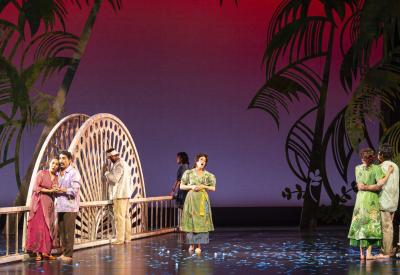
			<content:encoded><![CDATA[<p>The San Francisco Opera premiere of Rachel Portman’s <em>The Little Prince</em> was a great success Friday night at Zellerbach Hall. Anyone who has seen the drawings in Antoine de Saint-Exupéry’s novella, <em>Le Petit Prince</em>, will immediately recognize it as the inspiration for Francesca Zambello’s whimsical production, jointly presentated by San Francisco Opera and Cal Performances, and conducted by Sara Jobin. The action takes place on a stage of gold and azure framed by a circular frontispiece out of which appear stars, lamps, baobabs, and water, just to name a few. The costumes were clever in concept and design, most notably the velvet-petaled Rose and the Baobab sprouts that “grew” onstage. The latter were, hands down, the favorite of the 12-and-under set.<br />
<img src="http://www.sfcv.org/images/littleprinceset_wide.jpg" class="photo" /></p>
<p class="caption">The set of <em>The Little Prince</em></p>
<p class="photocredit">All photos by Kristen Loken</p>
<p>The event was a destination for many parents and doting grandparents. The younger audience members they brought seemed to enjoy the show immensely, although with its running time of two hours (including one intermission), it may be a bit too much for anyone under seven or eight. An outing to Zellerbach Hall would be well complemented by a trip to the bookstore or library to read all or part of Saint-Exupéry’s novella and see the author’s own illustrations.</p>
<p>Portman is mainly known as a composer of film scores. Her credits include <em>Emma</em> (Academy Award for Best Film Score), <em>The Cider House Rules</em>, and <em>Beloved,</em> among many other recognizable titles. Her music shows its roots in film scoring with its facile harmonies, sweeping phrases, and minimalist arpeggios. The moving ensemble number that ends Act 1 outweighs the finale of the opera and leaves the work as a whole feeling a bit unbalanced. And yet, while the hard-core composers of academia might dismiss Portman’s foray into the more classical medium of opera because of her music’s “commercial” trappings, her work joins beautifully with the text of librettist Nicolas Wright to form a drama that was enjoyed by a public that stopped listening to academia long ago.</p>
<h2>Well-Matched Performances</h2>
<p>Tovi Wayne was charming in the title role with his tousled yellow hair and blue jumpsuit (another nod to the illustrations of Saint-Exupéry’s book). His voice is clear and bright and his portrayal of the prince’s innocent detachment was completely believable. Eugene Brancoveanu sang the role of the Pilot with ease. His rich, ringing baritone filled every corner of Zellerbach Hall and then some. The onstage chemistry between the Pilot and the Prince, the projection of his inner child, was palpable and the work would have been an empty shell without it.</p>
<p><img src="http://www.sfcv.org/images/wayne.yang_wide.jpg" class="photo" /></p>
<p class="caption">Tovi Wayne (The Little Prince) and Ji Young Yang (The Rose)</p>
<p>Ji Young Yang played an elegant Rose. It was a pleasure to hear her crystalline soprano voice in a smaller venue than the War Memorial Opera House as it allowed us to appreciate more of the fine nuances of her instrument. She did overpower the rest of the ensemble with her long, lyrical vocalisms in the Act 1 finale and Jobin should have reined her in just a bit to preserve balance. Marie Lenormand, in her first role with San Francisco Opera, held her own as the Fox. Her voice may not be quite as developed as those of some of the other heavy hitters in the cast, but she more than made up for it with her playful romping with the Prince.<br />
<img src="http://www.sfcv.org/images/choruses.prince_wide.jpg" class="photo" /></p>
<p class="caption">Eugene Brancoveanu (The Pilot) and Members of S.F. Girls Chorus and S.F. Boys Chorus</p>
<p>The San Francisco Boys Chorus and the San Francisco Girls Chorus did well. They had excellent ensemble, tuning, and diction and were a pleasure to watch onstage first as stars and later as cranes. The choristers as a bed of roses in Act 2 were especially delightful. Rich Fisher and Christopher Sprague added magic from behind the scenes with their lighting design, especially during the “Watching the Sunset” music in the first act.</p>
]]></content:encoded>
			<wfw:commentRss>http://www.sfcv.org/2008/05/06/charming-voyage/feed/</wfw:commentRss>
		</item>
		<item>
		<title>Musical Fragrances in the Air</title>
		<link>http://www.sfcv.org/2008/05/06/musical-fragrances-in-the-air/</link>
		<comments>http://www.sfcv.org/2008/05/06/musical-fragrances-in-the-air/#comments</comments>
		<pubDate>Tue, 06 May 2008 19:05:30 +0000</pubDate>
		<dc:creator>By Jonathan Russell</dc:creator>
		
		<category><![CDATA[review]]></category>

		<category><![CDATA[contemporary music]]></category>

		<guid isPermaLink="false">http://www.sfcv.org/2008/04/29/musical-fragrances-in-the-air/</guid>
		<description><![CDATA[On Monday at the Yerba Buena Center for the Arts, the San Francisco Contemporary Music Players presented a polished, energetic performance of four colorful recent works by composers from the United States, Argentina, and France.
The most effective of these works was Reynold Tharp&#8217;s gorgeous San Francisco Night (2007), a premiere which closed the concert&#8217;s first [...]]]></description>
			<content:encoded><![CDATA[<p>On Monday at the Yerba Buena Center for the Arts, the San Francisco Contemporary Music Players presented a polished, energetic performance of four colorful recent works by composers from the United States, Argentina, and France.</p>
<p>The most effective of these works was Reynold Tharp&#8217;s gorgeous <em>San Francisco Night </em>(2007), a premiere which closed the concert&#8217;s first half. Inspired by a visit to our fair city in 2006 (Tharp was also a doctoral student at UC Berkeley for several years), <em>San Francisco Night </em>is a sensuous evocation of the colors and atmospheres of the Bay Area. Adding trumpet and French horn to the standard Pierrot plus percussion lineup, Tharp conjures an endlessly varying wash of musical fragrances, swirling and reconfiguring like the mists that sweep up over Twin Peaks.</p>
<p>Not content to write textures that are merely interesting or surprising, Tharp concocts sounds that are also ravishing and intoxicating. He has studied in France, and I could hear a strong connection to such French composers as Debussy, Ravel, and Messiaen, informed by more recent advances in extended instrumental techniques and the Spectralist school of composition. Like the opening of Ravel&#8217;s <em>Daphnis et Chloé </em>suite, or the birdsong passages of Messiaen, Tharp&#8217;s textures are full of burbling activity, yet they are also fleet and airy.</p>
<p>In his program notes Tharp mentions that Debussy once said he wished to create &#8220;an orchestra without feet&#8221; — an apt description of Tharp&#8217;s orchestration, as well. The music rises and falls, ebbs and flows, but it never lands. Although the work was 15 minutes long, I was so caught up in it that it seemed to be over in an instant, and I wished I could be enveloped in its sensual landscape for far longer.</p>
<h2>Jazz Inflections</h2>
<p>If Tharp&#8217;s work could have lasted longer, Frenchman Bruno Montovani&#8217;s concert-closer <em>Les Danses interrompues </em>(Interrupted dances), composed in 2000, despite some very compelling colors and textures of its own, lasted a bit too long. Abruptly alternating sections of vigorous activity and calm repose, this work included some fresh ideas, such as complex rhythmic unison passages for the entire ensemble, rapidly repeated notes that sped up and slowed down at unexpected rates, and quarter tone–inflected melodies hinting at jazz. After too many iterations, however, these gestures began to grow tiresome and the sudden shifts and juxtapositions that were initially so captivating became predictable. <em>Les Danses interrompues </em>was basically an enjoyable piece, but ran too long to sustain the ideas on which it was based.</p>
<p>Opening the second half, Argentinian Martín Matalon&#8217;s <em>Formas de arena </em>(Forms of sand) (2001), created surprisingly dark colors with its instrumentation of flute, viola, and harp. Beginning with busy, perpetual-motion rhythms, the piece eventually wound down to a gently hypnotic ending. The brightness of color usually associated with flute and harp was subverted in this work by the frequently percussive use of these instruments, with loud thwacks emanating from the harp, and frequent breath attacks on the flute, like distant drums. These sounds mixed with propulsive viola patterns into a darkly driving texture.</p>
<p>David Felder&#8217;s <em>partial [dist]res(s)torations </em>(2001-2003) opened the concert with incisive rhythmic unisons and a buoyant first movement. Subsequent movements settled down into more lugubrious textures, and while it contained many compelling and original colors, it never quite lived up to the promise of those exciting opening bars.</p>
<p>Throughout the concert, the performers, under David Milnes&#8217; energetic and incisive conducting, played with the precision and intensely focused energy that I have come to expect from this fine ensemble. Flutist Tod Brody and clarinetist Carey Bell stood out for their sharply detailed playing.</p>
<p>Although I have no major objections to any of the pieces presented, for my taste the program did seem somewhat aesthetically homogenous. All the pieces were predominantly concerned with texture and color, and all had a decidedly European stylistic orientation. A piece or two on the program with a different aesthetic angle would have thrown these texture-based pieces into welcome relief.</p>
]]></content:encoded>
			<wfw:commentRss>http://www.sfcv.org/2008/05/06/musical-fragrances-in-the-air/feed/</wfw:commentRss>
		</item>
		<item>
		<title>Dulled Impact</title>
		<link>http://www.sfcv.org/2008/05/06/dulled-impact/</link>
		<comments>http://www.sfcv.org/2008/05/06/dulled-impact/#comments</comments>
		<pubDate>Tue, 06 May 2008 19:05:08 +0000</pubDate>
		<dc:creator>By Jason Victor Serinus</dc:creator>
		
		<category><![CDATA[review]]></category>

		<category><![CDATA[symphony]]></category>

		<guid isPermaLink="false">http://www.sfcv.org/2008/04/29/dulled-impact/</guid>
		<description><![CDATA[What is all the fuss about Mason Bates? The 31-year-old DJ cum classical and electronica composer, whose works have been championed by his teacher, John Corigliano, has received both a Rome Prize and an American Academy in Berlin Prize. Even before the San Francisco Symphony followed the lead of at least eight other orchestras and [...]]]></description>
			<content:encoded><![CDATA[<p>What is all the fuss about Mason Bates? The 31-year-old DJ cum classical and electronica composer, whose works have been championed by his teacher, John Corigliano, has received both a Rome Prize and an American Academy in Berlin Prize. Even before the San Francisco Symphony followed the lead of at least eight other orchestras and awarded him a commission for next season, the California Symphony, which has an enviable track record of championing young composers and artists who go on to major careers, had selected him as its 2007-2010 Young American Composer in Residence.</p>
<p>Certainly Bates is a personable and charming fellow. As the third person to address the audience at California Symphony&#8217;s Sunday matinee in the packed Dean Lesher Center in Concord, he carefully introduced several sections of his four-movement <em>Music from Underground Spaces,</em> about to receive its premiere. After each explication, he tediously made his way to the back of the players, picked up his briefcase-sized electronic pad, and proceeded to merge his electronics with the orchestra in extended examples.</p>
<p>[Note to the California Symphony: I understand how hard it is these days for arts organizations to muster the financial support they need. But two consecutive PR spiels (one by Barry Jekowsky tooting his own horn), followed by an extremely long composer explication, delayed the start of the program by 18 minutes. Please give us more compact presentations in the future.]</p>
<p>When the piece finally got going, my impression was similar to what I experienced last August at the Cabrillo Music Festival. There, conductor Marin Alsop&#8217;s reading of Bates&#8217;s <em>Rusty Air in Carolina </em>led me to comment in <em>American Record Guide,</em> &#8220;Beyond the charming visuals, an affable jazzy middle section, and a genial feel, the orchestral writing seemed lightweight, the themes undistinguished.&#8221; Here, I had trouble staying awake.</p>
<p>In Bates&#8217; words, &#8220;<em>Music from Underground Spaces </em>marries orchestra and electronics to vividly conjure up a variety of underground worlds.&#8221; The first movement, &#8220;Tunnels,&#8221; &#8220;where subways roar past kaleidoscopic orchestral figuration,&#8221; supposedly includes &#8220;propulsive motives and driving techno rhythms&#8221; that transition from &#8220;blurry activity to slow-motion ambience.&#8221; The subsequent &#8220;Infernos&#8221; purports to feature &#8220;surreal effects &#8230; where a demonic techno groove, paired with flickering figuration, moves the work into one hell of a nightclub.&#8221;</p>
<p>After the &#8220;sparkling netherworld&#8221; of &#8220;Crystalline Cities,&#8221; the piece ends with &#8220;Tectonic Plates,&#8221; an earthquake-country-inspired finale that features &#8220;beautiful and eerie earthquake recordings&#8221; processed by Peggy Hellweg of the Berkeley Seismology Laboratory.</p>
<h2>Tame Sonic Ride</h2>
<p>It all sounds wonderful on paper. But as someone who was born in Manhattan, and who spent five days in the Big Apple less than a week ago, I swear on my Katz&#8217; Delicatessen kosher pastrami sandwich that Bates offered the tamest, least clattery subway ride in the shortest string of cars I have ever ridden in. (Maybe he recorded the subway from across the Hudson.)</p>
<p>Yes, there was a danceable techno beat, with the woodwinds amiably bubbling along as though Ecstasy were nothing more than a harmless sedative. But before long, &#8220;Tunnels&#8221; devolved into warmed-over Steve Reich without the mesmerizing looping and subtly changing patterns that make for Reich&#8217;s greatness. Several movements later, the surprise Bates had promised the audience in &#8220;Tectonic Plates&#8221; turned out to be some barely noticeable, innocuous low rumbles, laughable in the face of the ominous booming that rocks my own windows from the souped-up Buicks of Oakland&#8217;s barrio.</p>
<p>While pondering whether Bates&#8217; popularity lies in his ability to merge electronica with orchestra in ways that will never upset a conservative audience, I awaited the visceral thrills and equally conservative harmonies of Carl Orff&#8217;s <em>Carmina Burana.</em> Another fizzle. From an orchestra seat under the balcony overhang — not a good place for anyone, especially not a critic — the Oakland Symphony Chorus, together with the Contra Costa Children&#8217;s Chorus Honors Choir and full orchestra, only approached bacchanalian levels at the very end.</p>
<p>Part of the problem lay in the Oakland chorus&#8217; inherent imbalance (only a third of the chorus is male, and three of the 12 &#8220;tenors&#8221; are women). Yet even the orchestra itself, including the percussion, seemed incapable of achieving anything remotely orgiastic.</p>
<h2>Soloists to the Rescue</h2>
<p>The performance&#8217;s saving grace was its three soloists. Baritone Keith Phares, who recently partnered with the beloved Frederica von Stade in the Houston Grand Opera premiere of Jake Heggie&#8217;s <em>Last Acts </em>(retitled <em>Three Decembers </em>in its forthcoming San Francisco Opera premiere), is also on the roster of the Metropolitan Opera. No wonder. His voice is gorgeous, resonant on the bottom, thrillingly full on top, and capable of a caressing falsetto that merges seamlessly into full voice. The man seemed capable of summoning more power than half the orchestra and chorus combined. Every note was to savor.</p>
<p>Soprano Kiera Duffy, a finalist in the 2007 Met&#8217;s National Council auditions, got better as she went along. Duffy made an impressive showing in her frequently excerpted solo, <em>Dulcissime </em>(Sweetest one), which was quite beautiful save for a somewhat screamed high D. But she must cease drawing attention from her fellow soloist by swaying and making expressive faces rather than sitting respectfully while he rightly commands the stage.</p>
<p>Tenor Tyler S. Nelson, given a single, impossibly high assignment, got better with each repeat, and by the third stanza the lower resonance of the voice had clicked in. His glowing ease and sweet, sterling top suggest a great future.</p>
<p>Conducting the proceedings, Barry Jekowsky danced up a storm on the platform at the finale. If only the performance had followed suit.</p>
]]></content:encoded>
			<wfw:commentRss>http://www.sfcv.org/2008/05/06/dulled-impact/feed/</wfw:commentRss>
		</item>
	</channel>
</rss>