Music Features
Every week, our writers take an in‐depth look at an artist, program or topic of interest to us. Spend some time with this week's classical music feature, or scroll through the extensive SFCV archive for insights in many music topics.
The new pipe organ at St. Mark’s Lutheran Church in San Francisco is making itself known among organ aficionados in the Bay Area. Not only is it beautiful to look at, with an outer case and carvings in black walnut, but it has a beautiful sound, as well. It was dedicated on March 25, 2007, and the congregation and concertgoers have spent the past year discovering just what it can do.
More "Completely Organic" »Editor's Note: The new book Artists in Exile, written by the noted music critic and lecturer Joseph Horowitz, analyzes the ways in which émigré artists made an impact on American culture and were in turn influenced by it.
More "How to Become an American" »Ed Sullivan, it is said, had a surefire method for putting together a successful show: Open big, schedule a good comedy act, put in something for children, and keep it clean. If only planning a symphony season were that easy. Sticking to Sullivan’s formula, a symphony would need to start each concert with something like Copland’s Fanfare for the Common Man, move on to a piece by, say, Offenbach, add Peter and the Wolf, and avoid anything dissonant.
No, it’s far more complicated than that.
What would happen if you took the “postmodern” project to its logical conclusion and eradicated the theoretical, conceptual, and practical boundaries between large genres of music like, say, classical, jazz, popular, sound experiments, and electronic composition? That’s a major proposition that drives the leading edge, or bleeding edge (to use a technology term) of contemporary music.
Examples abound. The Meridian Arts Ensemble, a brass quintet with percussionist, plays at Stanford Lively Arts on Feb.
What would happen if you took the “postmodern” project to its logical conclusion and eradicated the theoretical, conceptual, and practical boundaries between large genres of music like, say, classical, jazz, popular, sound experiments, and electronic composition? That’s a major proposition that drives the leading edge, or bleeding edge (to use a technology term) of contemporary music.
Examples abound. The Meridian Arts Ensemble, a brass quintet with percussionist, plays at Stanford Lively Arts on Feb.
What would happen if you took the “postmodern” project to its logical conclusion and eradicated the theoretical, conceptual, and practical boundaries between large genres of music like, say, classical, jazz, popular, sound experiments, and electronic composition? That’s a major proposition that drives the leading edge, or bleeding edge (to use a technology term) of contemporary music.
Examples abound. The Meridian Arts Ensemble, a brass quintet with percussionist, plays at Stanford Lively Arts on Feb.
What would happen if you took the “postmodern” project to its logical conclusion and eradicated the theoretical, conceptual, and practical boundaries between large genres of music like, say, classical, jazz, popular, sound experiments, and electronic composition? That’s a major proposition that drives the leading edge, or bleeding edge (to use a technology term) of contemporary music.
Examples abound. The Meridian Arts Ensemble, a brass quintet with percussionist, plays at Stanford Lively Arts on Feb.
If the name Composers Inc. evokes thoughts of a corporate approach to music making, think again. This may very well be the most open-minded, eclectic new-music series in town.
Composers Inc. was formed in 1984 as a nonprofit advocate for living American composers. Its programming is determined by a collective of six artistic directors: Robert Greenberg, Rafael Hernandez, Frank La Rocca, Jeffrey Miller, Martin Rokeach, and Allen Shearer. All are active composers who support their habit by teaching or lecturing.
Mason Bates has a secret life. The Bay Area composer has a Juilliard pedigree, a Rome Prize and a Berlin Prize, and is currently composer in residence for the California Symphony. He's performed his work with the Atlanta and Phoenix symphonies, and locally been performed by the Cabrillo Festival, Oakland East Bay Symphony, and the San Francisco Contemporary Music Players.
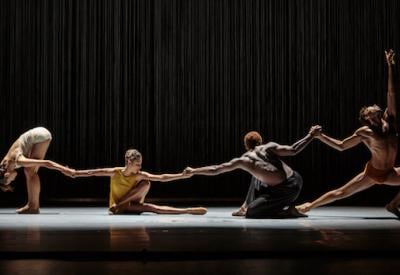
More "When Worlds Collide, and Boundaries Fall " »The Merce Cunningham Dance Company, as has become widely known, does not dance to music, nor does the music play for the dancers. Both exist in the same time frame, but they're created separately, as are lighting and decor. When movements or sounds will occur are determined randomly, using chance methods that go back to the earliest collaborations between Cunningham and John Cage.
More "A Chance Encounter" »