Classical Music Reviews
Every week, our professional critics attend concerts throughout the Bay Area to let you know what went well...and occasionally what didn't. Let their insights enrich your musical experiences, and feel free to share your own views!
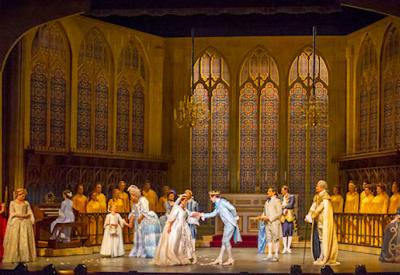
Gioachino Rossini’s La Cenerentola is a brilliant comic opera filled with both melancholy and satire. La Cenerentola is also a fairy-tale girl who bursts into the spotlight. And for San Francisco right now, Daniela Mack has become the Cinderella girl with the glass slippers. Never mind that when Rossini modernized Charles Perrault’s old version for his libretto, those slippers became matching bracelets. Mack, the vocal princess, is pure sparkle.
San Francisco has heard the greatest singers in this jewel of a coloratura mezzo-soprano role (Berganza, von Stade, Borodina).
Another weekend in July brought yet another summer festival to a close, with the final concert on Sunday afternoon of the Green Music Festival at Sonoma State University, in Rohnert Park. Artistic Director Jeffrey Kahane balances this festival, now in its eighth year, with a blend of regularly returning performers and new guest artists.
More »Sunday's matinee performance of Bach's St. Matthew Passion, a feature of the 70th anniversary season of the Carmel Bach Festival, memorialized Sandor Salgo. In doing so, Music Director Bruno Weil demonstrated a lack of insight into the great work's dramatic arch — the very insight Salgo was famous for during his long tenure at this festival's helm.
More »Music festivals, whether of the mini or maxi kind, invite audiences to think of music as part of an entire experience. For most of the year, we're content just to hear a concert. But the summer festival experience is also partly about location and lingering twilight. In this, American Bach Soloists holds a few cards that make its SummerFest programs irresistible, beyond the superior concerts that are the main reason for attending. The little St. Stephen's Church, nestled into a hillside near the bay in Belvedere, hosts ABS throughout its season.
More »Chamber music gluttons can always find satiation at the American Bach Soloists' SummerFest concerts. Each installment is a veritable orgy of music, food, and camaraderie, lasting a pleasantly staggering four hours.
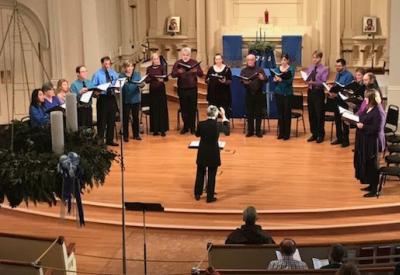
Sunday night was the final event of this year's summer series, featuring the Zivian-Tomkins Duo, performing several Beethoven sonatas for cello and piano; the Bay Area's newest a cappella vocal ensemble, Clerestory; and members of ABS playing some chamber works for strings (Brahms' Quintet Op. 111, No. 2; Schubert's String Trio in B-flat, D.
The German composer Hans Werner Henze, considered one of Europe's major composers of the '60s, '70s, and beyond, rarely gets a hearing in the U.S. One fan, however, will not take this neglect (is it simply old-hattedness?) lying down. Instead, the founder of the Worn Ensemble, Richard Worn, has organized all-Henze concerts to reenlighten the Bay Area as to the merits of this artist.
His latest concert at the Presidio Chapel in San Francisco (you can buy a poster of the previous one for $10) offered up four of Henze's chamber works for audience delectation.
Hundreds of thousands, millions, perhaps billions of people around the globe, had just taken the seven-point Live Earth Pledge to do their part to avert global warming. But in Walnut Creek on Saturday night, at the Dean Lesher Center for the Arts, it was business as usual.
More »In 1781, Joseph Haydn announced the appearance of a new set of string quartets, "composed in a new and special way, because I have written none in 10 years." The six quartets would appear as Opus 33, and would be Haydn's first authorized quartet publication in accordance with the terms of a contract he signed in 1779 with Prince Nicolaus Esterházy. With one of these works, No.
More »As the lights were going down in Davies Symphony Hall on Saturday night, I caught a line in the program book asking "What are we to make of Prokofiev ..." but had no chance to read further before the hall went dark. The question — after a childhood of mandatory Prokofiev in a Soviet-occupied country and a subsequent lifetime of listening to him by choice — didn't make sense. What is there to "make" of the composer of the ever-loving Romeo and Juliet, of the sparkling piano concertos, of great film scores?
More »Festivals should celebrate something that doesn't happen every day. The fourth and last program of the San Francisco Symphony's Prokofiev Festival was no exception to this ideal, with an unusual structure and repertoire adding spice to the expected high-quality performances and enthusiastic receptions that do happen most every day with this orchestra.
Structurally, the concert was really three concertlets: a piano recital, a piano concerto, and a concert of Prokofiev's "primitivist" works from 1917 and 1915.
SFCV Previews
- Sat May 18, 2013 8:00pm
Recent CD Reviews
-
Gardiner: Bach Cantatas
-
John Wilson Orchestra: Rodgers & Hammerstein at the Movies
-
Gordon Getty: Piano Pieces
-
L’Arpeggiata Mediterraneo
-
Emanuel Ax: Variations