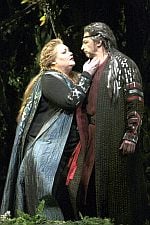
and Greer Grimsley
(Wotan)
For this third occurrence of the Wadsworth/Thomas Lynch production for Seattle’s quadrennial Ring, Speight Jenkins, the general director, again assembled a mostly excellent cast. There were a couple of notable exceptions. Only four in Das Rheingold were newcomers to the production, and these were gems, major factors. What I believe was also new was Wadsworth’s presentation of Wotan and Fricka as an affectionate, loving couple from the outset of Das Rheingold. Even their quarrels and recriminations are softened by Greer Grimsley’s bestowing a kiss or other affectionate gesture on Stephanie Blythe, as she looks into his eyes.
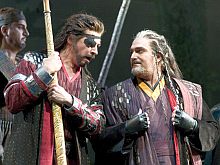
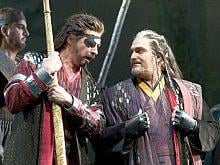
and Kobie van Rensberg as Loge
The humanizing extended to the normally brittle and snappish character of Loge, demigod of fire. The fine South African tenor Kobie van Rensburg, in his Seattle debut, portrayed a highly temperamental, almost-free spirit, even for a time seeming to side with the giants, Fasolt and Fafner, in their dispute with Wotan over the fee for building his Valhalla. And this Loge made a bigger thing of his insistent urging of Wotan to return the hard-won Ring to the Rhinemaidens.
Wadsworth kept the potentially static Giants-versus-Wotan scene in constant motion, the gods, Loge, and the giants circling around in a ceaseless choreography. The closing scene of the gods’ entrance into Valhalla, crossing the rainbow bridge in the distance, was endowed with added tensions projecting the story on to the succeeding operas. Fricka, gaining new prominence in this production, did not join the procession but remained behind to stand sadly contemplating the body of the giant Fasolt, slain by Fafner to gain possession of the deadly Ring. It showed her grasp of the grim future these events portended for the gods.
Meanwhile, the ever-restless Loge was storming to and fro while making his unambiguous prophecy of his role in that future. Their eyes met and Fricka slowly shook her head, understanding the hollowness of Wotan’s triumph.
Olympic Realm
Lynch’s sets, always shallow to give the singers the best acoustical advantage, and Martin Pakledinaz’ costumes preserve the traditional, realistic style in skillful designs. The opening and final scenes place the drama in what might well depict the Olympic forest, with towering pines and firs. Nibelheim, the underground realm, is revealed as a black wall of stone in striated layers of rock, veins of gold gleaming in the strata. It was most effective.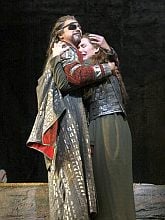
Janice Baird (Bruennhilde)
One Lynch strategy and economy is to bring sets back, serving the scenes’ various purposes but not necessarily to the best dramatic effect. Hunding’s hut in a dense, thickly entwined forest later becomes the setting for the Wotan-Fricka confrontation. The scene in Die Walküre for Brünnhilde’s appearance to Siegmund and the subsequent battle — a great rock wall on one side, and a high path and forest on the other — is repeated in Siegfried for both the “Forest Murmurs” and Death of Siegfried scenes.
Special effects worked their magic, with jets of fire shooting up from the ground to punctuate Loge’s presence and with flashes of fire in the air (actual fireworks) sparking from his hand, and, of course, a splendid ring of fire around Brünnhilde’s mountain bed.
Strong, often stirring singing, led by Greer Grimsley as Wotan, Stephanie Blythe as a great Fricka, and Stuart Skelton as Siegmund (making his Seattle debut), was the major musical force. Robert Spano conducted satisfactory performances by the Seattle Opera orchestra, excepting some dicey moments in the horns and occasionally the brass during Das Rheingold; he also accompanied the singers well. He kept the flow going musically but without inspiration, not digging in tough at the moments of power, drama, and intensity. But in general, tempos were on the slow side of the standard. There were no surges or telling flex that should go with the creative re-creation of Wagner’s music. Big statements went by the book; the stormy prelude to Die Walküre was a passing squall, sluggish and slow, though the Valkyries’ “ho-yo-to-ho” clamor was “nicely” done. It seemed as though the low brass was amplified at the climax of the Nibelheim scene, and certainly the anvil percussion was, too.
Grimsley was every bit the master god. His bass-baritone not only is big and untiring, it is voluminous, with ever-changing color, now intense and cutting, now dark, now ringing and stentorian. And he’s mobile and quick, his whole body the portrait of the mood and emotion. The shift he made from the towering rage at his willfully disobedient daughter, to the grief and loss shown at his final farewell from Brünnhilde, was tremendous, and the separation more loving and moving than I have ever experienced of other Wotans.
A Fricka for Our Time
Stephanie Blythe establishes herself with this production as the Fricka for our time: as proud as she is loving, and as determined as her mate — not, for once, a nagging shrew. Times have changed! Her voice, full, unstrained, and possessing, dominates the house. In another original stroke I’ve never known to have been done before, Wadsworth brought Fricka onto the Hunding-Siegmund scene, Hunding kneeling before her as Wotan commands, and then she mourning over his dead body,
 Stuart Skelton’s ringing, clear tenor, reminiscent of Set Svanholm’s, and his bold, confident carriage made his Siegmund an imposing, heroic figure. His singing carried the line beautifully, persuasive in its expression and broad emotional range. The Fasolt in Das Rheingold (his Seattle debut) and Hunding in Die Walküre was Andrea Silvestrelli, a big barrel of a man with a cavern of a bass voice, filling the house with its intimidating menace. Happily, neither he nor his brother giant, Fafner, sung by Daniel Sumegi (a fine bass, though with a less possessive sound), was equipped with the typical clutzy eight-inch platform shoes; they didn’t need them.
There were memorable performances in Das Rheingold by Richard Paul Fink, the classic Alberich of our era, and by an almost equally athletic Mime with a keenly projected tenor, Dennis Petersen, new to Seattle; also new to the company was the splendid, resonant, warm-voiced Erda of Maria Streijffert. Gordon Hawkins made an imposing presence as Donner; Jason Collins, strong as Froh; Marie Plette, an attractive but vocally unexceptional Freia. The Rhinemaidens were Julianne Gearhart, her soprano clean but thin, and Michele Losier and Jennifer Hines, whose mezzo was deep and rich.
The two heroines in Die Walküre were less than thrilling. Of Margaret Jane Wray, the Sieglinde, it can be said that while her large soprano voice could be often affecting and somewhat expressive, it did not bear the heroic line of her music, nor did she carry herself convincingly as an actress. Janice Baird simply does not have the voice for Brünnhilde and does not command the high register with the potency the role requires, becoming thin and even metallic. Her low register, though, is lovely and rich, suggesting a better future in very different, other than Wagnerian, roles. She acts winningly as a vital, sympathetic figure. The Valkyrie were Miriam Murphy, Sally Wolf, Luretta Bybee, Jennifer Hines, Marie Plette, Sarah Hetzel, Michele Losier, and Maria Streijffert, singing and moving as Valkyrie should. We could have done with less choreography for Wagner’s Rockettes, and without the stage business of their displaying their haul of slain warriors, full-size and as large dolls. That was one idea too many.