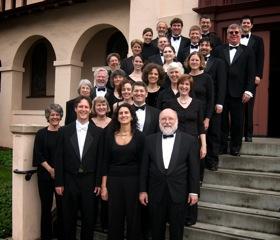
While Brahms composed the finest choral music in the 19th century, and a lot of it, try to find a performance of much of it today, aside from Ein Deutsches Requiem. Finally, one excellent chamber choir came up with a program worthy of “Johannes Brahms and the German Legacy.” The California Bach Society, performing it for the third time Sunday at St. Mark's Church in Berkeley, did proper justice to the subject, in a beautifully sung and fitting conclusion to its 40th season.
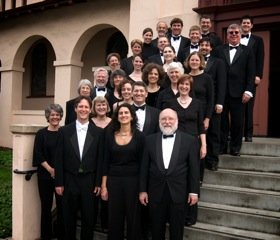
Brahms wrote his early motets while a choral director in Detmold. They’re much after Bach, and about as rich in contrapuntal design. In Es ist das Heil (It is our salvation), Brahms gives his chorale setting a five-part fugal treatment and then pulls the chorale back in as cantus firmus. Schaffe in mir, Gott (Create in me, O Lord), in three sections, develops canons, a fugue, a dialog between the female and male voices, and then another fugue. With all that complexity, the extraordinary thing was the expressiveness. That was Brahms’ doing, of course, but it was made manifest Sunday in the clear, handsomely paced and phrased performance led by California Bach’s director, Paul Flight.
This chorus of 28 is finely balanced, each section truly blended and exquisitely pitch-centered throughout the entire concert. Even when divided into the three double-chorus “Festival and Commemorative” Motets (1889), Op. 109 (which Brahms composed in gratitude for an award honoring his 60th birthday), the clarity in the performance kept the texture transparent, the texts lucid. These motets reflected Brahms’ take on the Renaissance choral tradition. In Unsere Väter hofften auf dich (Our fathers trusted in you), the antiphonal responses were not echoes in the manner of the 16th-century Italian masters but rather a dialog between the choruses. Wenn ein starker Gewappneter (When a strong man) was a keenly assertive setting of a text from Luke that seemed to foretell the current Libyan revolution. The singers rendered it with proper crispness.
The Brahms works were framed by compositions of his musical ancestors. Most telling as influences were those from the 17th century. Heinrich Schütz’ motetSelig sind die Toten (Blessed are the dead) contains a moving setting of a quotation from the Holy Spirit, sung pianissimo. For his predecessor, Johann Hermann Schein’s Die mit Tränen säen (They who sow with tears), conductor Flight sensitively drew out the pictorial expressive touches that have made this piece historically memorable.
To lead off the secular side of the program, Flight chose a charming “fa-la-la” madrigal by Hans Leo Hassler. Had it been sung in English as “Among all those on earth” instead of in its original German, Unter all’n auf dieser Erden, a listener would swear it was by Thomas Morley or Thomas Weelkes. Ludwig Senfl’s famous Das Geläut zu Speyer, setting the chatter of bell-ringers tolling in the bell tower, was a delight. Later, two Renaissance romantic pieces by Hassler seemed more a part of the legacy that Brahms absorbed.
Curiously, Schubert, Brahms’ major vocal inspiration, was absent here. He and the underlying folksongs could be detected in the early Seven Partsongs, Op. 62, the more sophisticated treatments notwithstanding. The California Bachers were gentle and persuasive with Rosmarin, and engaging with Von alten Liebesliedern, the stanzas ending on a cute line describing a horse trotting.
There was more: the gentle In stiller Nacht and the folkish Der bucklichte Fiedler (The hump-backed fiddler), as well as the Four Quartets, Op. 92 and 112, accompanied by piano, with the Brahmsian keyboard artfulness nicely rendered by Nalini Ghuman. I would have been hard put to give up any one of this program’s Brahms pieces, amounting to a treasure trove. All was so musically, sympathetically shaped and phrased by Paul Flight, not to mention his chorus’ being so finely fitted to the works and so appealing in sound and ensemble, that I would have happily sat through a repeat of the entire thing.
And Now for a Little Fauré, Plus a Wreck
But that wasn’t an option and, besides, another program called from the UC’s Hertz Hall nearby, given by the UC Alumni Chorus, conducted by Mark Sumner, in Gabriel Fauré’s beloved Requiem, followed by a somewhat mad take on that very piece called the 4A Wreck by Paul Ayres. The Requiem was supported by 24 instrumentalists (in reduced orchestration) and a keyboard synthesizer “organ,” and for soloists had a baritone of strong voice and some good qualities, Jeffrey Fields, as well as a soprano, Christa Pfeiffer, in less than good vocal shape. Sumner conducted it well, with evident sympathy and expressiveness, and his chorus of about 100 responded with a fair performance. The distinctive purity and elegant simplicity of Fauré’s style and ethereal design (notably in the unison Sanctus phrases) demand perfect intonation, but that was not always observed. Nonetheless, it was a satisfying performance.
For the 4A Wreck, Sumner doubled the chorus size by adding 100 undergraduate singers from his UC Choral Ensembles. Composer Ayres added all manner of variations and arrangements within the work’s seven movements, mostly holding to the basic Fauré harmony. The orchestra was now just strings, two pianos, and a drum set. A horrendous choral shout launched the Introit, followed by myriad variations — on the rhythm, with an underlying drum set laying down a rock beat now and again; on the voicings, with the part-writing enriched or turned into choral texture (“Dona eis” was changed into ad lib vowelization); and with the conclusion of the Hosanna powered up to an ear-blaster. Sumner conducted gamely, yet effectively.
A countertenor, Ari Nieh, his voice still developing, took over the Pie Jesu solo, and a chorus baritone, Ken Wait, performed a “gangsta rap” insert, amusing the near-capacity audience. Finally, the “In Paradisum” was wholly different, departing from the Fauré music. The chorus variously hummed and softly vocalized many notes of the final major chord as everyone gradually strolled off the stage, some strumming string instruments brought from home, others carrying little electric candles, continuing the chord out into the lobby and external spaces. No incense was burnt, otherwise the scene seemed right out of the ’60s.
A serious composer might do a fine homage based on the Fauré, inspired by the original’s elegance, spiritual and classic breadth, and elevation. This was quite obviously something else, not necessarily disrespectful but certainly not affectionate, more of an exploitative take. Oh, and the title: 4A Wreck. That was explained as an inside joke that, as such, is best taken internally, one way or another.