January 30, 2010

Operatic Heaven From Hell

Ensemble Parallèle
By Jason Victor Serinus

Ensemble Parallèle sold itself short by emphasizing that their two performances of Alban Berg’s nightmarish early-20th-century opera, Wozzeck, would fill the breach left since San Francisco Opera last performed the work in November, 1999. Heard and seen in the relative intimacy of Novellus Theater at Yerba Buena Center for the Arts, the West Coast premiere of John Rea’s 21-musician chamber reorchestration needed no apologia. Ensemble Parallèle’s oft-devastating, 90-minute multimedia wow of a production was whole and complete unto itself.

Conductor Nicole Paiement, who intends to mount annual productions of contemporary operas in San Francisco, and her stage director/husband Brian Staufenbiel paid equal attention to Wozzeck’s musical and theatrical elements. Ensemble Parallèle played as if on fire. Equaling their commitment was an outstanding cast of singer-actors, a number of whom have performed with San Francisco Opera and other major companies. Media artist Austin Forbord and set/lighting designer Matthew Antaky furthered unified the effort, creating a cumulative impact greater than the sum of its considerable parts.

Knockout Opening

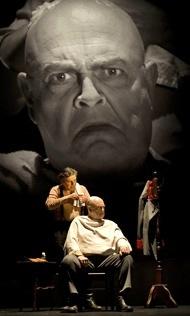
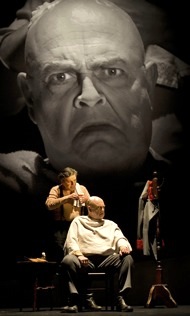
The production wasted no time making its mark. Staged within a quasi-deco frame, the opera opened with Wozzeck (Bojan Knezevic), an oppressed militiaman and regimental servant of the Captain (John Duykers), shaving his master. As Duykers lectured and hectored his deeply troubled servant, an onstage video crew projected his every grimace and eyebrow raise in perfectly focused black and white on a screen behind the duo. The portrayal, mesmerizing in its obsessively lurid detail, emphasized the weight of Wozzeck’s burden in its larger-than-life proportions. That the video was fed through a computer program that projected it slightly out of synch further heightened the hallucinatory aspects of Berg’s score.

Ironically, Duykers’ tour de force underscored one of the few weaknesses of the production. Although Knezevic’s body language was true, his dramatic powers could not equal either Duykers’ or those of his other oppressor, the Doctor (Philip Skinner). Nor did his voice possess all the weight and cutting edge that his role demands. Unintentionally dwarfed by the great Duykers, whose weakening with age, pinched top nonetheless suited his cartoonish role to perfection, Knezevic’s portrayal lacked the eloquence that penetrates deep into the heart. Even extended prerecorded video of his aqua-demise could not evoke the sympathy that the role demands.

Seen on a significantly smaller stage than in the War Memorial Opera House, Skinner made an even stronger impression than he did as the towering, vengeful Bonze in San Francisco Opera’s Madama Butterfly. Intentionally rigid and mechanical in his movements, the Doctor displayed complete control over his “scientific” experiments on his deeply troubled guinea pig.

What a demented duo Skinner and Duykers made! Their meeting on the street, with the Doctor reciting all the afflictions that might strike the Captain, was a classic case of two nutcases giving lip service to rational discourse.

Light Amidst the Darkness
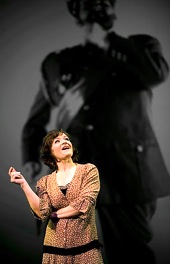
The sole notes of beauty in the opera came from Wozzeck’s lover and mother of their child, former prostitute Marie (Patricia Green). Although she betrayed both Wozzeck and her adorable innocent child (Kai Nau) by allowing herself to be seduced by the Drum Major (AJ Glueckert), her posture was so naturally regal, her voice so beautiful, and her entrapment so total that she touched the heart far more than Wozzeck. Although Green’s online resume describes her as a mezzo-soprano, the Canadian artist’s strong high C surpassed the screeches of many a bigger name Marie. Staufenbiel tastefully choreographed the fully dressed seduction scene to perfection.

Paiement did not skimp when casting other roles. J. Raymond Meyers was a solid Andres, Erin Neff a strong Margret; and John Bischoff (First Apprentice), Torleff Borsting (Second Apprentice), and Michael Desnoyers (Madman/Soldier) all shone when given opportunities to emerge. In the entire chorus of constantly inebriated soldiers and whores, only one young man looked like he didn’t know what to do with himself.

Standouts
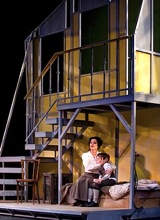
Several images and scenes continue to haunt the memory. One is the preposterously oversized black and white projection of the overstuffed Drum Major marching like a pea-brained peacock. Others are of the boy hopping along on his hobby-horse, and Marie admiring her earring-adorned self in the shard of a mirror. And the constantly shifting, faintly projected parallel lines in the background, symbolic of everything from the ensemble itself to the instability and lack of connection between characters, were something special.

Watching the Captain and Doctor remain in character as they took their bows was worth its weight in gold. And, of course, every shot of Duykers grimacing like an operatic Jack Nicholson was priceless.

At the risk of repeating myself, the orchestra, frenzied and eloquent, was outstanding. True, 21 players could not summon up the weight that the final act intermezzo/epilogue requires. Nonetheless, the transparency of line, which laid Berg’s scoring bare, had an eloquence of its own. Paiement’s achievement was staggering.

Jason Victor Serinus writes about music for Opera News, Opera Now, American Record Guide, Stereophile, San Francisco Magazine, Muso, Carnegie Hall Playbill, East Bay Express, East Bay Monthly, San Francisco Examiner, Bay Area Reporter, hometheaterhifi.com, and other publications.

Comments

February 1, 2010
Great production

I thought Bojan Knezevic was stronger than you did, and I thought the orchestra was not quite as strong. But yes, this was an excellent production. And wonderful to see and hear it that lovely intimate space and not that big cold barn over on Van Ness.

February 1, 2010
A challenging and highly successful performance.

Two points, the first to the review and the second to the first comment.

1. Wozzeck is not an eloquent figure. He's a lowly enlisted soldier whose mind has been shattered over the course of years of abuse and twisted medical experimentation (I was an enlisted man in a past life so I have some experience with, and have some authority on The Suck). I'm not sure that he loses his sanity over the course of the play; I think he has already lost it, but his frustration comes to a head by the time he decides to murder Marie. If anything, the character should have no eloquence, just confusion, fear, frustration, and cognitive dissonance. Senior officers like the Doctor, the Captain, and the Drum Major are SUPPOSED to thoroughly dominate Wozzeck. That's the point.

2. I was in the orchestra and I can tell you that this re-orchestrated version is easily five times more difficult than the original for everybody involved in terms of its demands both in focus and technique. When you've got 20 players covering the parts of 100, something is going to give - there is no way for the interludes to be as lush as the original in such a severely reduced orchestra. Personally, I think we handled business like it was cool.

That's my story, and I'm sticking to it. And I have to say, yes, it was an incredible accomplishment on Nicole's part.

February 1, 2010
Wozzeck

I agree with everything except your review of Bojan Knezevic. I, along with the rest of the audience, found his performance both powerful and touching.

February 1, 2010
More Applause for Wozzeck

As a friend of Ensemble Parallele, I was hoping to be impressed by their production of Wozzeck - but I was not... I was simply blown away. From the first moment to the last -- the intensity, darkness and complexity of EP's production had me on the edge of my seat.

Not having any previous experience (or enjoyment) of modern opera before -- I found this production to be both deeply moving and absorbing. The multi-media aspects of the show -- particularly the black and white film -- were mesmerizing. From that first close-up of the Captain, to the blood stained red moon, to the layer of disorienting yet comforting fog, to the devastating images of Wozzeck drowning - every element of the production seemed perfectly placed.

As to the creators: Brian Staufenbiel's vision of this impossibly dark story made Wozzeck's misery and madness palpable. That Brian could create a world that at once seemed so brutally real and oddly dreamlike, was a great accomplishment. Ahh and Nicole Paiement's strength and passion seemed to be at the core of the show. There were times it was just as amazing to watch her conducting (with that remarkable focus and intensity), as it was to watch the action on the stage.

Just for a different perspective -- I thought Bojan's portrayal of Wozzeck was brilliant. He was both frightened and frightening -- and somehow showed that the line between human weakness and human madness is very thin. And for my money his voice (and eyes) were impressive and captivating.

So yes, I wanted to like Ensemble Parallel's Wozzeck - but never thought it would have such an impact. A shame really, that it was a short run -- but I am sure it will see another stage in the coming years... and I will be there (again) on my feet, yelling bravo!

February 2, 2010
Bojan Knezevic was amazing!

Loved the review and loved Ensemble Parallele's Wozzeck. You are right - Nicole Paiement's achievement was staggering as was that of the entire team. I've never seen her conduct before but hope for more opportunities.

I strongly disagree with your comments on Bojan Knezevic. I've always loved his voice and his portrayal - from the gorgeous sounds of his voice to the incredibly strong acting -- all of it just blew me away. I was sobbing at the end. His Wozzeck seemed so utterly devastating and sad that I was completely taken in -- he demonstrated a remarkable range for the character -- from brute strength to softness, from compassion to confusion, from love to madness. When he reached out for the hand of his child at the end of the scene with Marie, I just about lost it. On his face were all the emotions - the struggle of a father and lover who could not provide...someone alienated from those who love him. At the end I was almost stricken with sadness at his fate, at the helplessness of all of it. I wanted to run on stage and shake him and tell him that all would be ok - that he didn't have to kill Marie or end his life. Crazy, I know - but I was swept into the moment and it was real for me. I saw both performances and could have seen a third and fourth. I hope that he gets the chance to do this work in other places. This is someone who should have a major career in the opera houses of the world, but the Bay Area is incredibly fortunate that he's chosen to make his life here. Bravo to Bojan and to the whole cast.