
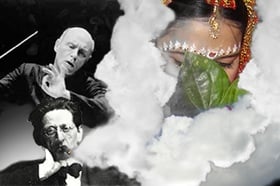
Guest conductor Christoph Eschenbach lit flames in two symphonies with the San Francisco Symphony at Davies Hall on Saturday evening. Whether he was conducting a familiar warhorse (Robert Schumann’s Symphony No. 4) or a rarity (Alexander Zemlinsky’s 1923 Lyric Symphony, a first performance by the Symphony — a fact omitted from the usual location in the program notes), Eschenbach made them sear. Joining him in the latter were the voices of bass-baritone James Johnson and soprano Christine Shäfer, so impressive that it hardly mattered that Zemlinsky’s apocalyptic orchestrations on occasion did some injustice to the sentiment in Rabindranath Tagore’s poetry.
The program began with a vigorous rendition of the Schumann, superbly controlled, yet with flexible rubato at all the right moments. Eschenbach exploited the fullest range of dynamics, heightening the music’s inherent drama. Exuding confidence and passion on the podium, the conductor was as interesting to watch as the music was to hear. Violin, cello, and oboe soloists did a fine job, though there were a couple of minor lapses in synchronicity of attack when their lines were doubled.
A Burden of Words
People can imagine what they like when listening to a “normal” symphony like Schumann’s, but when words and programs are attached, listeners must decide what to make of the composer’s literary intentions and their relationship to the music. Furthermore, some kind of structural rigor and logical progression should persist and not bend excessively to the external “story,” if a composer wants to adhere to the conventions that the term symphony implies.
From a formal standpoint, the work by Zemlinsky (1871-1942) is certainly a symphony. It is well organized. Surrounded by short orchestral interludes are seven Tagore poems about a male lured by adventure, a maiden infatuated with a prince, lovers’ tender exchanges, and regretful but somehow necessary separation. The symmetry of movement from isolation to intimacy and back to isolation again reminded me of a similar progression through the seven doors of Béla Bartók’s Bluebeard’s Castle. Tieing together the ordered segments, Zemlinsky utilized “cyclic” concepts of composition via the reappearance of germinal motives. The first such is a ponderous orchestral blast in dotted rhythm at the outset, worthy of a god of destruction. Yet when the orchestral introduction dies down, and Johnson sang the opening words to the same tune, they were “Ich bin friedlos,” translated “I am restless” — literally, “I am peaceless.” And herein lies the rub of the music.
The symphony was part of a trend in some quarters attempting to outdo even Wagner in grandiosity. There was an “instruments race” in parallel with the pre–World War I arms race, culminating in pieces like Gustav Mahler’s “Symphony of a Thousand” and finally in Eric Korngold’s gargantuan 1927 opera Das Wunder der Heliane. Note that the words are not exactly “I’m a warmonger,” and that they are followed by “I thirst for far-away things.” But Zemlinsky’s sound was an unmoderated Godzilla devouring New York.
Most of the time when the music climaxes, it is too overwrought for the subtlety of the poet. Had the symphony been composed for wordless vocalists, one could imagine monsters and be satisfied. But with words revealed, the listener, for example, has to fit “I flung the jewel from my breast” with music better suited to the elimination of Bikini Atoll.
Tender Moments
That said, the work contains many tender parts, beautifully imagined. A favorite section of mine was Zemlinsky’s treatment of “die sterne sind in Woken verloren” (The stars are lost in clouds), a diaphanous tincture of sound ravishingly delivered by Shäfer. Johnson, too, was in fine voice, though his stern visage and penetrating tones, like Zemlinsky’s music elsewhere, seemed a bit unsuited to the sensuousness of phrases like “You are the evening cloud floating in the sky of my dreams.” But then, if a more tender male singer were available for these portions, he would have been no match for the dense climaxes where Johnson shone through like a lighthouse in a tempest.
The beginning of the concert was delayed for about 15 minutes to accommodate latecomers having trouble getting over the Golden Gate Bridge. I wish the San Francisco Opera had delayed Salome last October for 24 hours when broken tie rods closed the Bay Bridge and prevented my passage. When the time comes to blow up the remains of that old span, Zemlinsky might be a good accompaniment.