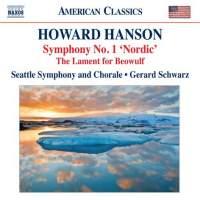
Our times should be ripe for a Howard Hanson revival. It’s OK to be tonal again; the 12-tone music of Schoenberg sounds passé; critics no longer shoot at sunrise composers who write memorable melodies. Hence Naxos’ re-release of Gerard Schwarz and the Seattle Symphony’s Hanson symphonies under the American Classics series is a welcome event.
In 1924, Hanson brought his Symphony No. 1, as a conductor, to the Rochester Symphony in New York State. Winner of the American Academy’s first Rome Prize three years earlier, Hanson was an up-and-comer. His symphony impressed the city big shot, “Mr. Kodak” George Eastman, and the rest was history: Hanson was quickly appointed the second director of the recently established Eastman School of Music and held the title (and a large influence in music education) for four decades.
When you hear the symphony today, it’s fun to imagine yourself in Eastman’s shoes. The work is businesslike, without undo repetition, and well-organized. The melodies do not stand out like something by Tchaikovsky: Turns by solo instruments are rare; many of the tunes are initially relegated to lower registers, but they are there, and reward repeated listenings. Hanson’s subtitle, “Nordic,” is based on his love of Sibelius and Grieg, though the music sounds little like that of those men. Hanson lacked Grieg’s knack for melody and harmonic piquancy. The low registers are indeed Sibelian, along with numerous drum rolls, but the sound is more American fresh than Finnish elemental. The first movement, in particular, is impressive in the cohesion and quality of its ideas. Considering how few Americans there were as well-trained and credentialed at the time, it was probably a no-brainer for Eastman to go after Hanson — even if he hailed (as he did) from Wahoo, Nebraska, a town named for a poisonous shrub.
Listen To The Music
Symphony No. 1 "Nordic" III. Finale (excerpt)The Lament For Beowulf (excerpt)
Purchase Recording


A portion of each purchase helps
support San Francisco Classical Voice
Hanson’s orchestration is solid, yet not as impressive as what European contemporaries were writing at the time. No sign of the rhythmic vitality of Stravinsky or the devil-may-care Jazz Age can be found. Still, the music is satisfying and enjoyable in a late-19th-century manner, and Hanson’s command of the orchestra grew quickly in his subsequent works.
The highlight of the music is the very interesting, if almost kitchen-sinky, third-movement finale. It begins as an expected scherzo, but suddenly morphs into a dramatic funeral march (listen to the excerpt) before returning to the fast material and a parade of the major themes of the previous two movements.
The release comes with Hanson’s 1925 Lament for Beowulf, an enjoyable choral work with awkward lines best ignored, like “Into burg then did they the rings and bright sungems,” and “Quoth they that he was a world King forsooth.” The performance quality of Schwarz and his band are excellent, and the sonics are terrific — especially when compared with the earlier recordings done in Mercury’s “Living Presence” style, which was highly praised by audiophiles with fancy equipment, but which lacked resonance and depth on ordinary machines.
If you like this symphony, you’ll especially be attracted to what is probably the best of Hanson’s symphonies, the Third (of seven). The Second is more famous because it has Hanson’s best melody (over-repeated, unfortunately), so it’s also worth a listen. Another plus for the work under review, and the other Hanson works, is that because they are re-releases, plenty of used copies are available on the market at considerable discount.