Photo by Norman U. Timorea
At 31, Alondra de la Parra is a conductor of immense promise, destined to lead a major orchestra — but first she has to work her way up through the minor leagues. Fortunately for Napa County, she made a brief stop Sunday with the Napa Valley Symphony, and the results were gratifying.
The concert took place at the recently restored, 1950s-era Lincoln Theater in Yountville, home to the French Laundry and other avatars of gastronomic and oenophilic excess. The local industry is much in evidence in the theater lobby, which features three wine bars and only two auditorium doors. Inside, the grape motif continues, with fuchsia walls and purple seat cushions.
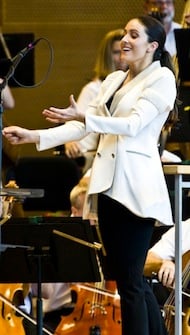
The implicit bacchanalia didn’t seem to affect the Mexican-American de la Parra, who was utterly sober throughout the concert and conducted with fastidious precision. Her movements and tempos are as well-regulated as an atomic clock, but that is only the foundation. What counts are the expressive gestures, usually made with her left hand, and the overall shape she brings to each piece.
De la Parra was most successful in the Brahms Symphony No. 1, which concluded the concert with a bang. From the opening insistent drumbeat, this was a performance driven by unrelenting rhythm and clear phrasing. Her tempos were not particularly fast, but she never let the orchestra get bogged down, no matter how thick the texture. She seemed to be calibrating the performance to the ability of the players, making sure that there were no mistakes and that each line was fully articulated.
The first movement set the tone, with de la Parra keeping steady time with the baton in her right hand, even as she swept elegantly with her left, bidding sections to swell, diminish, express, or whatever else five fingers and a well-oiled shoulder and elbow can communicate. She mostly conducted from the waist up, with her feet planted shoulder-width apart, her heels only occasionally coming together during moments of concentration.
Here de la Parra showed off her elegant, swanlike arm motions, and the orchestra responded in kind.
Wonderful solos from the oboe and clarinet began the second movement, a surpassingly beautiful and serene Andante. Here de la Parra showed off her elegant, swanlike arm motions, and the orchestra responded in kind. Perhaps the Andante lingered too long, for the third movement, Allegretto, was too slow and lacked dynamic contrast. Any disappointment, however, quickly vanished in the opening bars of the last movement, with its expectant pizzicatos and dramatic buildup. The arrival of the famous theme in the violins induced de la Parra to fully extend her arms, lift her heels, and even jump. Here at last she pushed the orchestra to its limits, getting convincing playing from every section. The standing ovation at the end was well-deserved.
Muted Strings
No ovations, standing or otherwise, greeted the pieces in the first half, which was restricted to the strings. The concert began with a lackluster performance of a slow-moving excerpt from Bachianas Brasileiras No.5 by Heitor Villa-Lobos. The piece was originally scored for eight cellos, and the transcription for string orchestra seems to have lost some heft. The performance was also hampered by somewhat less than unison playing in the violins. Perhaps more rehearsal would have brought the orchestra together.
Similar problems afflicted Twilight at Mt. Veeder, a brief tribute to a local landmark, by orchestra bassist Robert Wright. Like the Villa-Lobos, it moved slowly, yet with better dynamics from the orchestra. Some of the lush tremolo effects sounded muddy in the 1,200-seat hall, which has fairly thin acoustics.
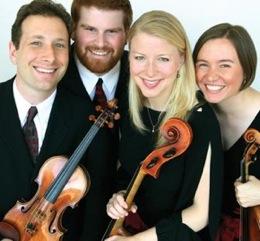
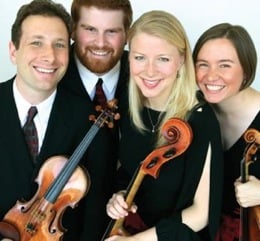
The orchestra and de la Parra didn’t really begin to click until a third party entered the stage, in the person of the Cypress String Quartet, offering a rare performance of Edward Elgar’s Introduction and Allegro for Strings, a one-movement concerto for string quartet and orchestra.
[The Cypress Quartet’s] playing seemed to inspire their fellow musicians.
The Cypress is well-known to Bay Area audiences from its base at San Jose State University, and it’s always a pleasure to hear them play. It was somewhat disconcerting, however, to see its members wearing soloist-style tuxes and evening gowns and keeping their eyes on the conductor rather than each other. They settled right in nonetheless and quickly displayed why they’re such a successful string quartet. Their playing during the Elgar, during which they often alternate with the orchestra, seemed to inspire their fellow musicians, and the entire ensemble became much more unified.
The Elgar itself is well worth a listen, with a wonderful viola solo and an unexpected fugue. De la Parra coordinated all the individual lines with aplomb, allowing the quartet to shine forth or recede as need be. While not as energized as the Brahms to come, the performance was memorable.
The applause was sustained enough that the Cypress offered an encore, a vivacious rendition of the last movement of Dvořák’s “American” quartet. Here the players reverted to their usual conductorless format, communicating with each other via raised eyebrows and the like. They are fun to watch, but even better to hear.