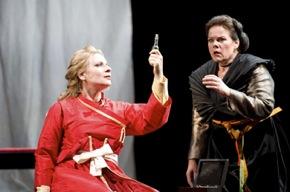
Were there the shadow of a doubt of the continuing and historic power of Wagner’s Tristan und Isolde to capture and move its audiences, this summer’s Seattle Opera production dispelled it, two major shortcomings notwithstanding. The leading strength in Thursday’s fourth of seven performances was, appropriately, the orchestra. It was led with a sure sense of the music’s intensities, expressiveness, and dynamic properties by Asher Fisch, principal guest conductor.
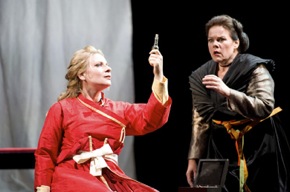
Photos by Rozarii Lynch
The remarkable acoustics of the Seattle Opera’s pit and house enabled the sound to bloom in all richness without covering the voices. The playing was well above that for last summer’s Ring cycle, perhaps due to generous rehearsal time and perhaps to personnel changes. All to the good. Topping that with mostly grand singing, Wagner’s music was the persuasive force it must be, more than compensating for a physical production that looked like something cobbled together out of storage.
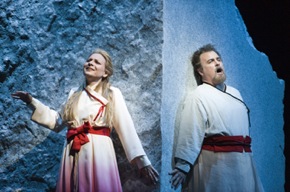
The cast was vocally strong, with a single disappointment: the sound of the Swedish soprano Annalena Persson, making her U.S. debut in this production. She is a comely, lithe blonde who acts with the passion that drives Isolde as the dominant lover. She was so forceful in this as to make clear Isolde’s psychological predisposition or repressed love of Tristan before the potion was administered. She was singularly intense through Act 1. All was well and good dramatically, but her pressing the voice for most of the opera resulted in an unyielding, shivery vibrato and a metallic sheath to the tone that was not pleasant. Although Persson has been singing as a dramatic soprano in major houses, the lyric sound that comes through when she lets up is her beauty spot.
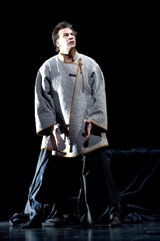
The Tristan was Clifton Forbis, an American with a strong, firm tenor voice of rich variety, yet a modest dramatic presence. He sang with a compelling range of expression, and intelligently. Forbis held back in Act 1, leaving all initiative to the storming Isolde. He paced his singing in Act 2, steadily expanding through the love duets to build in a grand line to the great climax. That care left him with strength and a fresh voice in Act 4 so that it was Tristan who was dying, not the tenor.
A King Marke of a Lifetime

A star of this performance was Margaret Jane Wray, soprano/mezzo-soprano, who, in a voice that beamed, made much of the opera’s conflicted and most interesting character, Isolde’s handmaiden Brangaene. Another was the King Marke of Stephen Milling, possibly the grandest sound, the fullest bass in my experience of this role going back to the 1940s and the great Alexander Kipnis. The generosity and all-encompassing warmth of Milling’s singing generated the deepest of sympathy.
Greer Grimsley, the Wotan in the 2009 Seattle Ring cycle, was Tristan’s devoted attendant/friend, Kurwenal, who delivered a penetrating, compassionate portrayal in his rich bass-baritone. Jason Collins, a tenor with an arresting dramatic voice, was telling in the short, crucial role of Melot, Tristan’s friend and betrayer. In the roles that framed the opera, the Sailor and Shepherd and the Steersman were excellently done by Simeon Esper and Barry Johnson.
As for the production, by set and costume designer Robert Israel, all three acts were located in one stage-size box of a set, with a large oblong window on the back wall accepting projections of the sea and sky, silhouetted figures of a shepherd, a watchman — and, at the beginning, Tristan on watch. Large packages wrapped in white and tied with string (my guess was paintings in storage or awaiting shipment) leaned on the wall stage left, as if left there by accident. A table and other furniture were at hand. The best of the visual aspect was the ample lighting, the avoidance of the literal “night” darkness embraced in the text and the clothing of the lovers in white robes. Costumes for the men were curiously Chinese, possibly Mongolian in outline. Red was a key color in the production.
A red rope like a clothesline, stretched across the stage above head-height, carried a white sheet or curtain employed by the stage director, Peter Kazaras, to screen actors for no reason more apparent than to create activity. His best work was in managing the physical relationship between the lovers so as to avoid actual contact while expressing their yearning. This was, after all, an unconsummated affair. Kazaras was also responsible for several deliberate, dramatically inexplicable blunders. When Tristan challenges his betrayer, Melot, and the two duel, Tristan drops his sword deliberately, allowing Melot to stab him: self-sacrifice, presumably penance. Here, Kazaras had them fighting behind the sheet with Tristan emerging wounded so that the audience never sees the truth of the action.
Inexplicable Death Blow
Near the opera’s end, when Kurwenal is defending Tristan from what he mistakenly believes to be the malevolent forces of King Marke, he is supposed to go offstage where he is mortally wounded and then return to die. Kazaras has him just sitting there and, before our eyes, with no enemy in sight, receiving his death blow from an unseen assailant (a lightning bolt?) and, untouched, dying. When King Marke at the discovery finale scene of Act 2 reaches the climax of his painful reproach of Tristan, he falls to his knees, and, later at the ultimate death scene, again collapses. This is against the tradition of sustaining the King’s nobility and dignity in grief.
When Isolde finally reaches Tristan at the end, Kazaras has her walk with an excruciatingly slow, measured pace as if to his funeral. This, the love-driven woman who has been rushing madly across the sea to get there, is seen taking an interminable time to cover 30 feet to reach the side of her beloved, who is not yet dead. Finally, in the concluding measures of the great “Love-Death” aria, her demise was handled as of someone carefully lying down to sleep. It didn’t work.
Israel, responsible for the controversial Seattle Ring production of 1986, and Kazaras seem to have been pursuing what are today described as “concepts,” elevating to the level of interpretation what used to be known as “gimmicks.” Happily, Wagner — and the music — won.