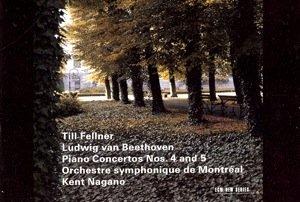
Like the footsteps of a life partner, Beethoven’s music is heard so frequently that it’s easy to take it for granted. But listen to Austrian pianist Till Fellner’s ECM New Series CD of Beethoven’s Piano Concertos No. 4 and 5, performed with the Orchestre Symphonique de Montréal under Kent Nagano, and the love affair is renewed.
After Fellner’s brief entrance, Nagano’s orchestral introduction to the Piano Concerto No. 4 in G Major melds lyrical beauty with grandeur. When the piano finally reenters, its tender, graceful line bubbles over with melody. Fellner’s emotion is contained; he lets Beethoven’s dizzying scales and runs speak for themselves, without interjecting a surfeit of poetry. The expression comes more from the impeccably voiced notes themselves than from any special shading or rubato.
While this approach is certainly effective in more-declamatory passages, Fellner’s and Nagano’s second movement Andante misses the mark. Listen, for example, to an almost 63-year-old recording from Clara Haskil and Carlo Zecchi, and you encounter an intense dialogue between an initially towering and emphatic orchestra and a dwarfed, reticent piano. Over the course of five minutes, the piano slowly emerges, expressing its lament with such time-stilling, aching simplicity that the orchestra bows to its eloquence. Pianists Wilhelm Kempf and Stephen Kovacevich also voice the Andante’s tender heartbreak in highly individual ways that stop the breath.
With Fellner, the tender core of Beethoven’s remarkable outpouring remains hidden. It’s as though he and Nagano have not found the means to together express the aching in the composer’s heart. The piano’s last notes are voiced so prosaically that it sounds as if the line trails off because Beethoven has run out of things to say. Contrast that to Kovacevich’s and Colin Davis’ ending, where the line dies off like the last, lingering flickers of hope.
Listen to the Music
The Fourth’s marvelously emphatic finale, like much of Fellner’s and Nagano’s Fifth in E-flat Major, aka the “Emperor Concerto,” is far more successful. Transitional passages, which in some hands are voiced with magical, almost diaphanous beauty, are approached in a more straight-ahead manner. But neither party has any difficulty speaking with strength and eloquence.
Louis Lortie, in his recent performance of the Fifth with the Leipzig Gewandhaus Orchestra, made his greatest impact in the second movement Adagio, which he played with ineffable tenderness. As in their Fourth, Fellner and Nagano go only so far. It’s almost as though they wish to ensure that Beethoven’s softer side does not infringe on his nobility and grandeur. Their approach pays off in a thrilling final Rondo allegro. Still, listeners who want yin and yang in equal measure will find themselves appreciating this substantial achievement, and then turning elsewhere.