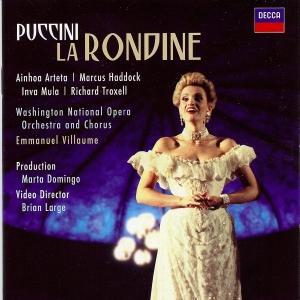
In her commentary on WNO’s 1998 production, Domingo notes that Puccini “was never quite satisfied with the result of his work.” Especially unhappy with Adami’s libretto, Puccini ultimately created three versions of La Rondine, with two different endings.
Domingo’s revised performing version includes a first-act aria for Ruggero, initially published in the 1920 German score, and “new” first- and second-act duets between Magda and Rambaldo, created for Puccini’s second version. The original words for these duets clarify Magda and Rambaldo's relationship, and insert perfectly into existing orchestral passages that lacked vocal lines in the first version. Most important are a third-act duet between the two, for which Lorenzo Ferrero has written new orchestration to replace music thought destroyed during World War II, and the opera’s very different denouement.
Equipped with new music that adds dramatic depth to characters and relationships, Domingo has opted for Puccini’s alternate ending. Instead of having Magda leave the love of her life, Ruggero, who despairs as Magda sadly flies back to her caged life as Rambaldo’s mistress, Magda walks into the sea and drowns herself after Ruggero rejects her. So much for criticism that Puccini was incapable of writing anything more than a one-tune, wishy-washy operetta that lacks a dramatic climax.
Listen to the Music
La Rondine Finale - Alternate Version
What is anything but tragic is the superb singing. Soprano Ainhoa Arteta’s Magda may not be as physically free and hyperactive as Gheorghiu’s (Domingo gives everyone far too many stock gestures), but her beauty and softly floated, radiant high notes are a constant pleasure. Arteta’s big aria, “Chi il bel sogno di Doretta?” is a triumph. The same is true of tenor Marcus Haddock’s ringing, vocally exceptional Ruggero, though not of his little-lost-boy persona. At first, it seems strange to hear Ruggero’s first-act arias and subsequent duets sounding like reprises of “E lucevan le stelle” (from Tosca) and the love scenes from Tosca and Madama Butterfly, but once the tragedy becomes clear, it all makes sense.
Soprano Inva Mula, who recently appeared here in L’Elisir d’amore, cannot approach Anna Christy’s endearing lightness, though she sings quite well. In keeping with the opera’s tragic ending, Richard Troxell creates a far weightier Prunier, and William Parcher a much uglier Rambaldo. I’d love to see what the same cast would do in the updated, 1920s production we saw here, especially with Ion Marin or Nicola Luisotti in the pit. But Domingo’s additions and revisions create an entirely new La Rondine, one that will lead to revised and, dare I say, far more positive assessments of the work.