March 12, 2011

The Jonas Kaufmann Phenomenon

Cal Performances
By Jason Victor Serinus

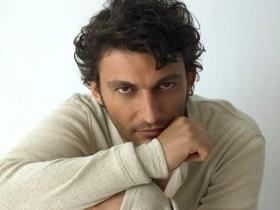
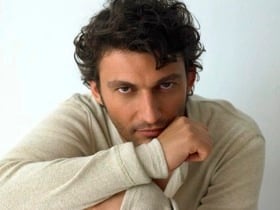
To prolonged high-pitched cheers and applause, Munich-born tenor Jonas Kaufmann, 41, strode onto the stage of Zellerbach Hall. In the presence of his gifted accompanist, Helmut Deutsch, the tall, dark, handsome, and extremely curly-headed singer smilingly greeted an adoring audience eager for his Bay Area debut.
Unamplified, but with electronically enhanced 1.5 second reverberation provided by Cal Performances and Meyer Sound, the tenor launched into an extremely generous lieder recital that included four songs from Schumann’s Kerner Liedern, Op. 35, the entire Dichterliebe, Op. 48, and 13 songs by Richard Strauss. After that came five encores, the last made possible by Deutsch’s iPad copy of the score. Those who stayed through the entire 2 ½ hours experienced one of the most versatile, compelling, and vexing recitals in memory.

Will the real Jonas Kaufmann please ...

Kaufmann’s unique instrument is as multifaceted as a complete response to the rapidly changing emotions of German romantic poetry and music demands. One minute, he sounds like a heldentenor, with the gleaming high tones of an artist preparing for his imminent Metropolitan Opera role debut as Siegmund in Wagner’s Die Walküre. Then he softens, and you’d swear that you’re actually listening to a lyric tenor who is pushing his instrument to its limits.

When Kaufmann sings lower in the range, the production is so easy and full that you imagine he’s a baritone with a high extension. Upon occasion, the tone is throaty, almost gruff, as if to give credence to fears that he is singing on principal rather than interest. But then the clouded tone or covered phrase passes, and all you hear is glory.

The effect, at least for this listener, is unnerving. If the voice, like the eyes, is an avenue to the soul, Jonas Kaufmann’s core is so complex that you can’t be exactly certain who he is. He’s a sweetheart, almost a pussycat one minute; three bars later, when he’s seamlessly swelled from almost falsetto-like purity to the clarion-like fortissimo of a Wagnerian hero, you sense that you pet this tiger at your peril.

Gifts

Beyond his instrument, which is head turning in and of itself, Kaufmann brings rare intelligence to his repertoire. Without in the least sounding fussy or overcalculated, his wealth of shading revealed that he not only understood but also deeply felt what he was singing about.

Take the 16 songs of the oft-programmed Dichterliebe, with text by Heinrich Heine. The contrast with last week’s baritone rendition by Eugene Chan, and previous Cal Performances tenor versions by Ian Bostridge and Rolando Villazón, was striking. There were no eccentricities of tempo, and no attempts by Deutsch to show how penetrating he could be by grandstanding and lingering too long in the pianistic postludes. Instead, we experienced two firmly committed, deeply probing artists whose responses arose directly from the notes and words on the page.

There were multiple miracles. To express the youthful gush of love and joy in Die Rose, die Lilie, die Taube, die Sonne (The rose, the lily, the dove, the sun), Kaufmann managed the eight lines of the rapid, two-stanza song in only three breaths. Every note and word was clearly produced. Then, in the next song, when he sang, in translation, “Yet when I kiss your lips,” his very different sound grew inward and deeply passionate. And while others have sounded less pressed in the high climax to Ich grolle nicht, the flexibility of tempo and extreme dynamic swell to the peak were exemplary.

Few singers can so fully embrace the ironic ditty of a tune that is Ein Jüngling liebt ein Mädchen (A young man loved a girl) as did Kaufmann, who managed to sound sing-songy in the beginning and deeply wounded in the end. To instantly transition from his almost venomous outburst of anger and hurt to the heart-breaking softness of the exquisite An leuchtenden Sommermorgen (On a shiny summer morning) bespoke artistry of the highest order. Equally poetic was Deutsch’s handling of the final pianistic postlude, which lingered on one phrase, sped up the next, and ended with shocking abruptness.

Ah, that Strauss!

For anyone accustomed to the Strauss performances of his two finest 20th-century soprano exponents, Elisabeth Schumann (whom Strauss adored and accompanied) and Elisabeth Schwarzkopf, Kaufmann offered a very different way in. In place of silvery tones and gravity defying, feathery highs came the passion of a man at the height of his powers. The contrast between the extremely soft ending of Freundliche Vision (Pleasant Reverie) and the huge declamation that concluded Ich liebe dich (I love you) was, if Valley Girl superlatives be allowed, totally awesome.

Equally stunning, the beautiful conclusion of Heimliche Aufforderung (Secret Invitation). Morgen (Tomorrow) was less successful, the opening vocal phrase rough, the declamation lacking ultimate flexibility. (Deutsch did much to compensate in the postlude.) But despite a pushed climax, the final song, Cäcilie (Cecily), was thrillingly exultant.

Marvels continued in the encores. Kaufmann’s rendition of Lehar’s beloved Dein ist mein ganzes herz (You are my heart’s delight) rivaled that of its dedicatee, Richard Tauber. The difference was that Kaufmann’s honeyed sweetness on soft notes was produced, not by falsetto, but by a masterfully controlled, finely tapered full voice. The final selection, Schumann’s Mondnacht (Moon), was sung with such caressing softness and complete control that it was hard to believe that it came at the end of an extremely long recital. As vexing and even troubling as Kaufmann’s vocal production may be, his artistry is supreme. And he does look fabulous.

Jason Victor Serinus writes about music for Opera News, Opera Now, American Record Guide, Stereophile, San Francisco Magazine, Muso, Carnegie Hall Playbill, East Bay Express, East Bay Monthly, San Francisco Examiner, Bay Area Reporter, hometheaterhifi.com, and other publications.

Comments

March 15, 2011
Jonas Kaufmann is great. We

Jonas Kaufmann is great. We love him all so much.Amazing.

March 15, 2011
Jason Victor Serinus' review of Jonas Kaufmann Concert

Thank you SFCV, for posting such a thoughtful, impressively thorough review of Kaufmann's recital!  Serinus' review caught the subtleties of Kaufmann's technical mastery, as well as both the physical beauty of his voice and the depths of his musicality.  Serinus himself is obviously a most astute musician as well as a thoroughly "readable" writer.

Appreciatively,

Cheryl North

March 16, 2011
Review of Jonas Kaufmann in recital

At last a perceptive review of Kaufmann as an artist in recital that looks seriously at what he has to bring to this genre of vocal music.  Thank you for a nuanced appraisal of an unusually intelligent singer who has mastered so many facets of effective communication, technical acumen, and expressive, character and text-driven singing unafraid to challenge himself and his audience. We need more writing like this on the arts.  Lesley K.

March 17, 2011
Jonas Kaufmann

I hate to be a wet blanket, but I was unmoved by Kaufmann's Dichterliebe.  Perhaps I've been spoiled by having heard so many other great singers.  On recordings, Fritz Wunderlich's performance of this work is simply more beautiful to hear, and his vocal technique is superior.  I've seen Placido Domingo in person a number of times, and he had a better vocal instrument and much richer low notes--plus Domingo really knows how to connect with his audience.

The second half of the concert was much more satisfying.  Kaufmann seems to have a real emotional connection to the music of Strauss, and his performance of many of the Strauss Lieder could hardly be surpassed.  As to the encores--I would gladly spend an entire evening just listening to Kaufmann perform Viennese light opera.

March 17, 2011
I wonder how his voice will

I wonder how his voice will age. He's already got a heavy vibrato.

March 18, 2011
Kaufmann recital

  Thank you for such a thoughtful and astute review.  Kaufmann's beautiful singing and Deuch's exquisite playing touched me but I do not have the words to describe the experience and give it justice.  I wish the reviews of this recital in our regional "major" newspapers even approach the caliber of your review. 

March 18, 2011
Kaufmann's recital

I agree with some of the comments, and his top notes are quite strained and flat to my taste.  

I was wondering whether the main repertoire of the evening Dichterliebe should have properly been followed by R. Strauss' songs for the second half, although it defies the logics of programming. 

To me, he is rather an operatic singer than a Lieder singer, and some of DVDs, like in Carmen, are quite nice to watch.

Pil Orbison in Berkeley

March 26, 2011
Jonas Kaufmann

Well, I'm commenting rather late but have been thinking about this recital since I heard it.  I went in with great expectations based on some amazing recordings.  Alas, I have to agree with Pil:  Kaufmann was strained and flat on the high notes in the Dichterliebe.  I did, however, appreciate the rapport he seemed to have with his pianist and also appreciated that they did not dally between songs in the cycle.  To my mind this is how a lieder cycle should be heard; only the briefest of pauses between songs.


Still, I do look forward to hearing him again.  

October 31, 2011
Jonas Kaufmann

Jonas Kaufmann is a crooner who believes he is like Richard Tauber but mr. Kaufmann is not as good as Nicolai Gedda was. What is that ugly baritone sound of Jonas Kaufmann?

December 10, 2011
Jonas Kaufmann, baritone

Am sitting here, listening, in frustration, to today's Met broadcast of Jonas Kaufmann's baritonal FAUST. His singing has become the 'Emperor's New Clothes' of tenordom. Although, if he had been doing this a couple of decades ago, we might have heard the brilliant high-baritone Thomas Allen as Faust. My guess is he has too much integrity to play this game. Kaufmann only singing as a tenor on studio CDs does not cut it. He's a compelling person to watch but the slight-of-hand is transparent and very sad.

December 28, 2011
Uneven and artificial?

I went to this recital as a huge fan of Jonas Kaufmann, seeing him as a candidate for "world's current greatest singer" and have to say, I was a little disappointed (my respect for his ability to perform such a huge recital so effectively notwithstanding!)

I first heard him in Zurich when he stepped in for an indisposed Jerry Hadley as Faust in Berlioz' Damnation and he was sensational with an easy high D flat, gorgeous looks and voice, impeccable technique and musicality, and a passionate intelligent interpretation. Stunning. Last year I heard him as an eagerly awaited Lohengrin in Bayreuth and, although excellent I already felt he was manufacturing an overly dark sound and his interpretation was a little mannered.

I felt the same in Zellerbach, and, although there were many great things about the recital, his singing in Dichterliebe was uneven. The top notes sounding less easy than they obviously could (as demonstrated in the encores) possibly owing to his, once more, favoring such a darkened tone. I heard Thomas Hampson perform Dichterliebe some years back and he sounded more tenorial. The interpretation was remarkable in it's range, but, and this is always going to be a challenge when one has such a studied technique and wide palette to choose from, somewhat intellectual and lacking in sincerity. The highlight for me was "Dein ist mein Ganzes Herz" and I left wishing I had had the opportunity to hear him let rip on a few more lyric opera and operetta numbers.

I must say, that these comments are tempered by the realization that it was he, and not I, that got up and performed, and I repeat my respect for his ability to take on a challenge of such magnitude and be great, if, maybe, not the greatest.

December 28, 2011
Jonas Kaufmann

To those disappointed by or finding fault with Kaufmann's singing, please take yourselves out of your own context and try to understand where he actually comes from, and what he is trying to achieve as an artist after years of searching. Read about his approach and inner evolution on his website or in his book "Meinen die wirklich mich?" to appreciate what his singing means to him...

A true artist doesn't try to please the gallery, but follows his "inner voice" to the deepest of his capabilities, to the darkest recesses of his being and into the wake of the most luminous inspiration. What matters to Kaufmann now is to work with as much variety of repertoire and vocal expression as he can muster, to explore the richest palette possible, and give back to the world what he has elaborated within his own body/instrument and sensibility over years of hard work. This is not about some unmaintainable perfection, or fitting within artificial categories of voice types, but rather about expressing the elaboration of one's own being in the context of recreating the composer's vision to the utmost of one's human limitations. If you take risks and experiment, you will sometimes falter... What I see and hear is an artist creating his own standards, having broken free from his own cultural hang-ups and embracing a world of infinite nuance, inhabiting every role (and song) with great sincerity and integrity.

December 31, 2011
#4 The Jonas Kaufmann Phenomenon

Great review. Thank you SFCV and Jason.