June 5, 2011
Out of the Ashes, a Goddess Emerges
Related Article
S.F. Opera’s Götterdämmerung a Complete Work of Art
Another perspective on Götterdämmerung from Robert P. Commanday
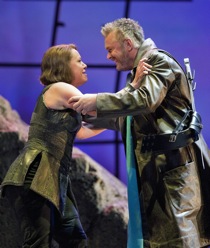
Over four and a half hours after the curtain rose on Wagner’s Götterdämmerung, soprano Nina Stemme advanced to the center of an empty stage. With shoulders squared and feet planted firm, she stared into the vastness of the War Memorial Opera House and began the “Starke Scheite.” Starting with, in translation, “Stout logs you must collect for me in a pile on the shores of the Rhine,” her stunning, intensely passionate projection of Brünnhilde’s monumental Immolation Scene affirmed that she is the rightful successor to the great Brünnhildes of the past.
Making her role debut as the Götterdämmerung Brünnhilde, Stemme sang as if she had owned the role for at least a decade. Capable of far more than sheer decibels, she poured forth sounds that were full, round, seamless, and incontrovertibly gorgeous from top to bottom. Her rapturous exaltations of love were filled with warmth and tenderness. Even when her feelings changed and she sang of battle and betrayal, her far darker tones revealed the aching heart at their core.
It was a magnificent portrayal. The entire race of the gods had burned to ashes by the opera’s end. Yet when Stemme reappeared alone onstage, the collective cheers from a standing audience affirmed her status as a living Wagnerian goddess.
Universal Strengths
Stemme was not the only artist making a role debut. Tenor Ian Storey (Siegfried), bass Andrea Silvestrelli (Hagen), soprano Melissa Citro (Gutrune), mezzo-soprano Daveda Karanas (Second Norn and Waltraute), alto Ronnita Miller (First Norn), soprano Heidi Melton (Third Norn), and mezzo-soprano Renée Tatum (Flosshilde) all excelled in first outings of their respective roles. Together with bass-baritone Gerd Grochowski (Gunther), baritone Gordon Hawkins (Alberich), soprano Stacey Tappan (Woglinde), and mezzo-soprano Lauren McNeese (Wellgunde), they made for one of the strongest casts that General Manager David Gockley has brought us.
Sharing the spotlight with the singers were the final installment of director Francesca Zambello’s and set designer Michael Yeargan’s vision of the Ring, and the glorious sounds of the S.F. Opera Orchestra. Coming full circle from Das Rheingold, which we revisit when the first of SFO’s three complete Ring cycles opens on June 14, scenes transitioned from Brünnhilde’s once-lonely rock and a litter-strewn Rhine to the steel and glass palaces of the corporate oligarchy.
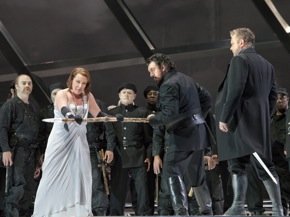
Inevitably, a few anachronisms surfaced: Uzis sharing the stage with swords, an unseen horse galloping toward skyscrapers, and a hideous, ill-fitting Act 2 gown for Brünnhilde that looked even worse for the warrior boots. Nonetheless, the contrast between the beauty of the natural world and the destruction of post–Industrial Age capitalism was both vivid and visceral.
In a production abetted by Mark McCullough’s intelligent lighting and a host of video projections by Jan Hartley with S. Katy Tucker, the deeper meanings of the Ring were there for anyone who wished to take them in. The final denouement, which took us full circle to images seen in Das Rheingold, ended with an affirmation that brought tears to the eyes.
Only once, during the Siegfried Rhine Journey, did the video projections seem at odds with the pace of the music. But that was in part because, in an afternoon filled with exceptional playing whose eloquence penetrated as deeply as the singers’, conductor Donald Runnicles momentarily lapsed into autopilot. Traversing purely orchestral terrain that every great Wagnerian conductor and wannabe has recorded, he created the orchestral equivalent of a visitor on BART asking, “Have we reached Civic Center yet?” Pick up the pace, stick to the schedule, keep sight of the goal ... you get my drift. But that sole slip into the mundane stood out only because the rest of the playing was so wonderful.
Hours of Splendor
Storey, the performance’s Siegfried, who sounds as if he has rebounded from the months of illness that left him unable to sing the role in both Götterdämmerung and Siegfried, gained in strength and steadiness as he went along. By the time of his extended scene in Act 3, a slightly pinched nasality was replaced by steady, glistening tone. This was a Siegfried who could keep up with his Brünnhilde, which is no mean feat.
Silvestrelli, singing Hagen, reaffirmed his status as a vocal giant. Towering over his cast mates, even without his made-for-a-giant elevator shoes (see SFCV’s Ring preview footage), his dark, gravelly instrument partnered well with the handsome darkness of Grochowski’s voice. The sounds and postures of both men contrasted wonderfully with Citro’s at times hilarious, yet ultimately sympathetic, Anna Nicole Smith–like Gutrune (complete with a slightly wild top that evened out as the opera advanced). Bring your binoculars for this one.
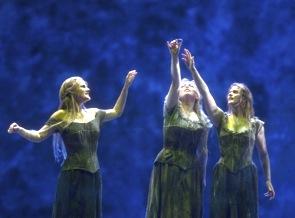
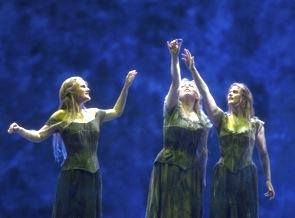
The three mellifluous Rhinemaidens (Tappan, McNeese, and Tatum), who were perfectly matched in volume and vibrato, provided a distinct contrast with the more individual sounds of the three Norns (Melton, Karanas, and Miller). Melton’s voice seems to have grown in size; with darker tones on top, she gave promise of a thrilling Sieglinde in the third cycle Die Walküre. Miller was steadier than her Erda of last week, the voice rich beyond belief. Although Karanas seemed a mite underpowered for this duo, her beautifully sung Waltraute displayed her finest and most convincing acting to date.
With a running time of over five hours, and a first act that lasts one hour and 50 minutes, Götterdämmerung can seem like an endless exercise in Wagnerian egomania. Yet, thanks to so many exceptionally gifted artists (both seen and unseen), it instead emerged as an ever-enthralling epic that held the audience spellbound. If this cycle comes out on DVD and Blu-ray, with sonics that match the visuals, it will surely reaffirm the company’s status as a world-class institution. Hey, even the critics lingered to cheer at opera’s end.
Recent CD Reviews
-
-
Handel: Atalanta
-
Gershwin: Orion Weiss
-
Rolando Villazón: Massenet Werther
-
Houston Grand Opera: Dead Man Walking


Comments
"Only once, during the “Siegfried Idyll,” did the video projections seem at odds with the pace of the music."
The “Siegfried Idyll” is not in Gotterdammerung, not even in the Ring.
This writer cannot ever be believed after making such a mistake.
Such trash.
Thank you for pointing this out. It's called trying to post as soon as possible. Hate to break it to you, but it happens all the time.
I briefly considered changing jobs to speechwriter for Sarah Palin. Instead, the copy is being corrected to read, "Siegfried's Rhine Journey."
jason
Everyone who makes it through The Ring Cycle - or even through this 5 and 1/2-hour marathon of an opera - should receive an "I Survived the Ring!" t-shirt.
Wagner was in serious need of an editor or producer to rein in his gargantuan ego and talent. There's too much boring exposition in The Ring. Hours (or what seem like hours) of people standing around and describing the plot may have been OK in the 19th century, but in this Twitter age it's dreadfully slow paced.
My favorite Ring opera is the first, Das Rheingold, because it's the shortest with the most action and least exposition.
It also has the longest wait for the bathroom. Two hours and thirty-five minutes with no intermission!
I still recall the ashen gray faces in the men's bathroom line at Seattle Opera. I recommend that everyone with small bladders begin dehydrating four hours before. The downside of high art.
I thoroughly enjoyed yesterday's performance of Götterdämmerung -- especially, as you said, the wonderful Brunnhilde and Hagen --, but as a newcomer to the opera (in general and to the Ring in particular), I have some questions about the staging and projections. This may be mere nitpicking, but in an otherwise wonderful afternoon of musical drama, these things seemed problematic:
1- The projections, which were technologically amazing and often gorgeous, struck a false note with me during Siegfried's Rhine Journey -- not because of possible shortcomings on the part of Maestro Runnicles, but because they seemed incompatible with the music. They showed a dry, cracked riverbed, strewn with litter, when the music was cheerful and beautiful. Why not save those bleak images for the end of the journey, when the music turns ominous? Here it seemed the video designer had disregarded the music for a singleminded flogging of a predetermined metaphor.
2- At the beginning of Act 2, the curtain opened on Hagen and Gutrune lying on a large bed in a motel-like bedroom, watching TV, handing a remote control back and forth. Gutrune left before Hagen went to sleep, but (as a newbie to this opera) I was given the strong impression that she and Hagen were lovers. This didn't seem to gibe with the genuine distress she showed in Act 3 about Siegfried's delay in returning from the hunt, and the genuine grief she soon afterwards expressed over his death. What gives with that? (I must also say, that scene seemed to lower the overall imaginative level of the afternoon.)
3- There were many places, particularly in the last acts, where the singers stood around on stage doing nothing while the music played on (and in these cases, the projections were not doing anything either). Is that normal for Götterdämmerung? It seemed less than ideally dramatic to me. The DVD's I'd watched of Rhinegold (Boulez, Bayreuth) and Siegfried (Levine, Met) seemed to do more with such stretches of orchestral music than yesterday's performance -- on the DVDs, the singers' faces at least expressed some emotion. ???
Hi Tom. Short Answer: It's opera. The whole premise is an absurdity.
Long answer: Your objections and concerns are valid. I raised one of yours in my review, Robert Commanday mentioned others in his, and there are many more than none of us has touched on.
Having said that, that Wagner's extremely talky libretto is nonetheless engaging and, on the level of myth, plausible, is no mean feat. Equally important is that Zambello's production so involved us that we care about its anomalies and contradictions. Many plots and productions are so absurd that nothing can keep us from either shrugging our shoulders or laughing the whole thing off.
If you think some things are off in this production, you should see Regietheater. When, during the Pamela Rosenberg regime, SFO ventured over to the other side with a production of Handel's Alcina in which men were beating women onstage, I was so infuriated by the violence and sexism that I couldn't even enjoy the excellent singing until the second act. Later, someone pointed out that since the women were singing men's roles, it was actually men who beating up men onstage. Chalk it up to my lack of imagination.
Nothing is normal for Götterdämmerung, or any opera production for that matter. People often stand around while artists sing music that either compresses or expands "real time." If everyone was involved with stage business all the time, the net affect would be to detract attention from the artist who's singing.
Watching a DVD is very different than watching a live performance. The camera engages in selective viewing; if people are standing motionless, you may only see the expressions on their faces, if anything at all. This production is to some extent a response to opera in the video and internet age, in that it attempts to keep us engaged in ways that a TV or internet-savvy audience would expect.
Having now seen Zambello's entire Ring, albeit in piecemeal fashion, I sense the unity of her conception. To me, it's strong. It's not without its problems. Yet even the things that don't ring true (no pun intended) tend to hold my interest, if not involve me further. It sounds like they did the same for you.
The bottom line is this. You are a first-timer, yet can see the flaws, and describe them acutely. And you thoroughly enjoyed the extremely long afternoon. To all of that, I say bravo.
Really enjoyed the opera this last Sunday from the balcony. The singing was magnificent and the opera vision helped so much with letting us watch (when we wanted) the close ups of the singers and action.
This review (with comments), as well as some other JVS recommendations, are a valued part of prep work for our very first Ring Cycle. I'm so glad we found svcv beforehand.