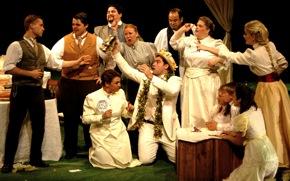
From rape to riotous wit. Such was the theme of veteran conductor Lorin Maazel’s Castleton Festival Opera Britten Project, as their four-performance Berkeley residency transitioned from the jealousy, rage, and horror of Benjamin Britten’s The Rape of Lucretia (1946) to the preposterous Victorian moralism of Albert Herring (1947).
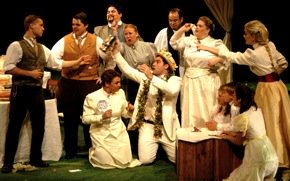
Photo by F&E Schmidt
Related Article
Maazel to Youth: Building Castleton
Lorin Maazel discusses the Castleton Project
Although these chamber operas were composed only a year apart, their similarities are more of musical brilliance than content. In probing the dark underbelly of the psyche, Britten and his librettist, Ronald Duncan, sought to overlay their terrible tale of rape, dishonor, and suicide in pre-Christian Rome with a surfeit of Christian moralizing and an equally suffocating plethora of Shakespeare-said-it-far-better verbiage. Just one year later, Britten and his director-turned-librettist, Eric Crozier, climbed out of the darkness into the light, making a mockery of small-town propriety in the imaginary, turn-of-the-century East Suffolk market town of Loxford.
When Merola Opera produced Albert Herring at Cowell Theatre in 2008, the chamber opera suitability of the relatively small venue, brilliance of the lighting, and near-ideal cast of youthful, eager singers made for an experience buoyant enough to lift the London or San Francisco fog. Here, in the much larger Zellerbach Hall, Nicholas Vaughan’s fog-heavy set, Rie Ono’s darker lighting, and cast members who seemed doggedly determined not to embrace the opera’s intentional stereotypes rendered Maazel and the Berkeley Symphony the stars of the show.
Orchestra Scores 10, Cast 3
The music of Albert Herring bubbles over with wit. From pseudo-marches that mock the “Onward Christian Soldiers” advance of Lady Billows and her cohort of morality enforcers to a host of gossiping woodwinds, Britten’s orchestra constantly mocks the morality playing out above the pit. Maazel and his Berkeley forces unfailingly illuminated this commentary with a sharp-eyed clarity that thumbed its nose at the Billows gang and celebrated goodie-good-boy Albert Herring’s inebriated fall from grace.
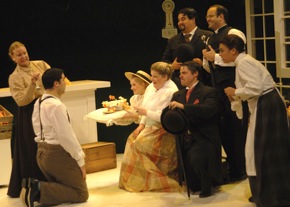
Unfortunately, it also set expectations for vocal performances that fell short of the mark. Most disappointing was Nancy Gustafson’s Lady Billows. Rather than looking like a dowdy spinster who used Bible and wealth to get her way, Gustafson came across as a physically fit Dancercise instructor who was taking her class through an operatic workout. The voice may have been blousy enough, but the impersonation failed.
Gustafson’s exceedingly mushy diction meant that if you failed to read the supertitles, you likely had little idea what she was singing about. And if you tried instead to get cues from her strong body, tapered waist, and smiling countenance, you would never have guessed that she was supposed to be Queen Victoria’s doppelganger.
Nor were her cohorts convincing. As her maid/assistant/slave Florence Pike, Kristin Patterson rarely hinted at her dissatisfaction with her servitude. Ashleigh Semkiw seemed far too lively and free for schoolteacher Miss Wordsworth, and Alexander Tall nowhere near pious enough for vicar Mr. Gedge. Worst of all, for a suffocating Mrs. Herring who had managed to tie her grown son to her apron strings, Rachel Calloway seemed sufficiently young and free to be Albert’s girlfriend. If Merola’s consistently young cast could pull off these roles, why couldn’t Castleton’s?
Compounding the problem were the set’s acoustically absorptive materials. As Harry the sound tech pointed out during one of the intermissions, voices carried so well during Rape because they were bouncing off a raked wooden platform. The set for Herring, by contrast, included an absorptive floor and backdrop. With only the most minimal Meyer Sound reinforcement provided by a few microphones secreted in the hall, some of the singers took a while to tune their voices to the acoustic and turn up the volume enough to make an impact.
Saving Graces
The brightest lights were Adrian Kramer as Albert Herring’s table-turning worker Sid, and Tammy Coil as his girlfriend and co-conspirator Nancy. Kramer’s delightfully fit, athletic body and turn-on-a-dime buoyancy did much to compensate for everything else that fell flat. Coil, too, was lovely, if not as energetically seductive or substantial as the outstanding Kramer.
Equally winning was Brian Porter’s Albert Herring, a mama’s boy through and through. Everything about his demeanor transformed after his night on the town. Porter, who celebrated his 30th birthday with his March 27 performance, is about to take a hiatus from opera to pursue a degree at Columbia University. Here’s hoping he returns.
The other bright lights were the three amplified children: Daphne Williams, Emma Thvedt, and Andres Beck-Ruiz. If only the role-embracing professionalism of these members of the Piedmont East Bay Children’s Choir could have rubbed off on some of their most-wanting adult costars.
Tyler S. Nelson sang beautifully as Mayor Upfold, and looked just enough out of it to suggest that Lady Billows was really in charge. Benjamin Bloomfield sang quite well, but could have been more endearing as the police superintendant who was incapable of policing himself.
Stage Director William Kerley, who drew convincing portrayals from everyone in Rape, must feel less at home in comedy. How many times did Sid and Albert Herring make the same jump to the same place? If only they could have lifted the rest of the cast up to their level.